Showing posts with label MIX10. Show all posts

Sunday, July 11, 2010

Archive and Mine Tweets In Azure Blobs with The Archivist Application from MIX Online Labs

Update 7/10/2010: Partially explained the date/time strangeness noted in the 7/4/2010 update as the result of Lotus 1-2-3 and Excel processing 1900 as a leap year, which it is not (see Figure 3 and below).

Update 7/8/2010: Karsten Januszewski (@irhetroric) explains How The Archivist Polls Twitter in his 7/7/2010 post to the MIX Online Labs blog.

Update 7/4/2010: Clarified PowerPivot’s problem with DateTime values in Excel data sources (see Figures 2 and 3) and added Tim’s Twitter user name.

imageKarsten Januszewski (@irhetoric) and Tim Aidlen (@Systim) appeared in a 00:22:41 Channel9 The Archivist: Your friendly neighborhood tweet archiver video segment of 6/28/2010, in which the pair explained the the objectives, structure, and data flow of their Azure-based The Archivist application for MIX Online Labs:

The Archivist is a new lab/website from MIX Online that lets people archive, analyze and export tweets. Here’s a little more about why we built The Archivist and who we built it for.

Sounds good, guys. Now, let's go learn about what this really means and how/why Karsten and Tim built this Twitter information analysis and archival service.

Learn more: http://visitmix.com/LabNotes/Intro-To-The-Archivist

The Archivist demonstrates Windows Azure’s potential for ad-hoc cloud data storage, data mining, mashup, and business intelligence (BI) applications. The project offers an API and you can download the source code from the MSDN Code Gallery, which describes the project as:

A Windows Azure service and ASP.NET MVC website that allows you to monitor Twitter, archive tweets, data mine and export archives.

The Archivist’s Architecture

The documentation says little about the project’s architecture, so here’s a data flow diagram I made from Karsten’s whiteboard drawing and narration:

image Figure 1

If you download a CSV file, open it in Excel 2010, and save it as an *.xlsx file, you can take advantage of PowerPivot to analyze large worksheets:

imageFigure 2

The following PowerPivot example uses a row filter on my Twitter user name:

image Figure 3

Update 7/10/2010: PowerPivot appears to interpret the fractional time component of an Excel DateTime value (see Figure 2) as the date equivalent of 0.#, where # is the fractional part of a double value. An Excel double (General Number) value of 1.0 corresponds to a DateTime value of 12/31/1899 12:00:00 AM, not the expected 1/1/1900 12:00:00 AM (see below), so PowerPivot treats 0.# as 12/30/1899, not 12/31/1899.

Date/Time conflicts between Excel’s and PowerPivot’s treatment of 0 as a null date and 0.# as a time value with a null date cause 0.# to appear as 12/30/1899 in PowerPivot instead of HH:MM:SS.

Following are tests of Excel VBA date/time expression in Excel 2010’s Immediate Window:

image  Figure 4

Excel VBA doesn’t recognize 2/29/1900 as a valid date because 1900 wasn’t a leap year. Executing the ? Format(#2/29/1900#, "General Number") expression throws a “Compile error. Expected Expression” exception and there is only a difference of 1 between the Double values of 2/28/1900 and 3/1/1900.

See Wikipedia’s Leap Year topic for rules to determine which century years are leap years:

Years that are evenly divisible by 100 are not leap years, unless they are also evenly divisible by 400, in which case they are leap years.For example, 1600 and 2000 were leap years, but 1700, 1800 and 1900 were not. Similarly, 2100, 2200, 2300, 2500, 2600, 2700, 2900 and 3000 will not be leap years, but 2400 and 2800 will be.

However, the Excel expression service does recognize 1900 as a leap year, as demonstrated by the expression is cells A1 and B1 of this worksheet. Ash Wednesday is 46 days before Easter Sunday:

image Figure 5

Microsoft Knowledge Base’s Excel 2000 incorrectly assumes that the year 1900 is a leap year (Article ID: 214326 - Last Review: January 24, 2007 - Revision: 5.4) states:

Symptoms: Microsoft Excel incorrectly assumes that the year 1900 is a leap year. This article explains why the year 1900 is treated as a leap year, and outlines the behaviors that may occur if this specific issue is corrected.

More Information: When Lotus 1-2-3 was first released, the program assumed that the year 1900 was a leap year, even though it actually was not a leap year. This made it easier for the program to handle leap years and caused no harm to almost all date calculations in Lotus 1-2-3.

When Microsoft Multiplan and Microsoft Excel were released, they also assumed that 1900 was a leap year. This assumption allowed Microsoft Multiplan and Microsoft Excel to use the same serial date system used by Lotus 1-2-3 and provide greater compatibility with Lotus 1-2-3. Treating 1900 as a leap year also made it easier for users to move worksheets from one program to the other.

Although it is technically possible to correct this behavior so that current versions of Microsoft Excel do not assume that 1900 is a leap year, the disadvantages of doing so outweigh the advantages.

Note: Microsoft Excel correctly handles all other leap years, including century years that are not leap years (for example, 2100). Only the year 1900 is incorrectly handled.

It appears to me to be up to the PowerPivot team to correct or at least document the problem.

Sample Public Archives

I created a public archive of my tweets (@rogerjenn), as well as tweets with #Azure and #SQLAzure hastags starting on 7/3/2010. You can access them from these links:

Note: Twitter provides access only to the last two weeks of tweets (less for trending topics) and The Archivist permits a maximum of three simultaneously active archives.

As you can see, I was the Top User of the #SQLAzure and #OData hashtags on 7/3/2010:

imageFigure 6

imageFigure 7

(I was #16 of the Top Users for the #Azure hashtag.)

Archived tweets appear in a list below the Chart Controls that’s sorted by date and time descending:

image

Visualizations

The site includes a Visualizations page that explains how to use the ASP.NET Chart Controls, which Microsoft acquired from Dundas Software, shown in the preceding captures. Clicking a control blows it up to full page size:

image 

Wednesday, March 24, 2010

Windows Azure and Cloud Computing Posts for 3/24/2010+

Windows Azure, SQL Azure Database and related cloud computing topics now appear in this weekly series.

 
Note: This post is updated daily or more frequently, depending on the availability of new articles in the following sections:

To use the above links, first click the post’s title to display the single article you want to navigate.

Cloud Computing with the Windows Azure Platform published 9/21/2009. Order today from Amazon or Barnes & Noble (in stock.)

Read the detailed TOC here (PDF) and download the sample code here.

Discuss the book on its WROX P2P Forum.

See a short-form TOC, get links to live Azure sample projects, and read a detailed TOC of electronic-only chapters 12 and 13 here.

Wrox’s Web site manager posted on 9/29/2009 a lengthy excerpt from Chapter 4, “Scaling Azure Table and Blob Storage” here.

You can now download and save the following two online-only chapters in Microsoft Office Word 2003 *.doc format by FTP:

  • Chapter 12: “Managing SQL Azure Accounts and Databases”
  • Chapter 13: “Exploiting SQL Azure Database's Relational Features”

HTTP downloads of the two chapters are available from the book's Code Download page; these chapters will be updated for the January 4, 2010 commercial release in March 2010. 

Azure Blob, Table and Queue Services

CloudHarmony’s Cloud Storage Showdown Part 2 - What is the best storage for your cloud server? post of 2/27/2010 (recently updated) analyzes data transfer performance of a variety of cloud service providers and hosting services, including Windows Azure blobs:

In the previous post we discussed cloud storage for consumers. Probably a more common use case for cloud storage is to enable backups and/or extended storage from cloud servers and platforms. Over the past month, we have used our network of 25 global servers running in various public clouds to measure bandwidth throughput and latency to and from various cloud storage services including Microsoft's Azure Blob Storage, Amazon's Simple Storage Service (S3), SoftLayer's CloudLayer Storage, Nirvanix Storage Delivery Network, Rackspace Cloud Files, and Box.net.

We conducted these bandwidth tests by reading and writing a 3MB test file (10MB for storage services in the same cloud such as EC2 to S3) to/from each storage services at random times twice daily. The results are separated by cloud server provider. The table displays all of the storage services tested within that cloud ordered by fastest downlink. We also tested storage in Microsoft's Azure platform.

The purpose of this test wasn't to measure the maximum throughput capacity between server and storage service, but rather to provide a comparison between different storage services. The 3MB test file is not sufficiently large for maximum capacity to be determined (for same cloud storage services the throughput will be more accurate because of the larger 10MB file size). Actual throughput for larger files will most likely be higher than the throughput calculations displayed here.

Following are CloudHarmony’s examples of Windows Azure data transfer performance:

South Central US (TX)

North Central US (IL)

North Europe (Amsterdam)

Southeast Asia (Singapore)

Cloud Storage Showdown Part 1 - Cloud to Consumer provides additional details on the techniques used.

<Return to section navigation list> 

SQL Azure Database (SADB, formerly SDS and SSDS)

My Enabling and Using the OData Protocol with SQL Azure post of 3/23/2010:

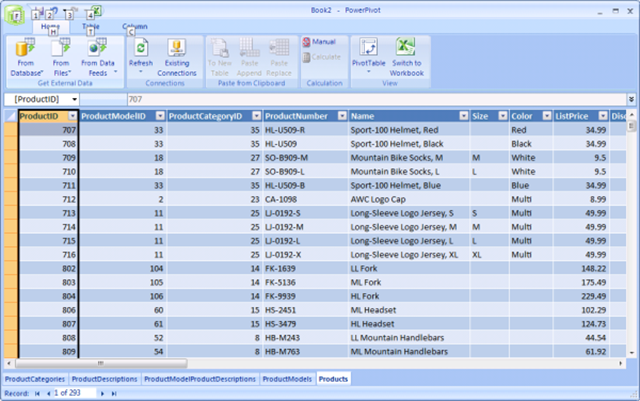
…shows you how to enable the OData protocol for specific SQL Azure instances and databases, query OData sources, and display formatted Atom 1.0 data from the tables in Internet Explorer 8 and Excel 2010 PowerPivot tables. A later post will describe using the OData protocol with SharePoint 2010 PowerPivot tables.

AdventureWorksAtomTableList600px_thu[6]

and continues with the instructions for munging OData content in Excel 2010 PowerPivot windows:

ProductsInPowerPivotWindow600px

(Repeated from Windows Azure and Cloud Computing Posts for 3/22/2010+ due to importance.)

David Robinson reports The SQL Azure Team is hiring in this 3/23/2010 post:

Are you passionate about the cloud? Do you think that data is cool? Are you looking to join one of the best teams at Microsoft? The SQL Azure team is growing and we are looking for talented Program Managers, Developers and Testers to join our team. Want to learn more about the opportunities? Check out the list of job postings here and either apply directly on the site or drop us an email @ cstref@microsoft.com.

The fact that the team is hiring bodes well for future SQL Azure features.

<Return to section navigation list> 

AppFabric: Access Control and Service Bus

The “Geneva” Team explains Using the Windows Identity Foundation SDK with Visual Studio 2010 RC in this 3/22/2010 post:

There are some known issues with using the WIF SDK on VS 2010 RC that do not exist with VS 2008. When VS 2010 is released, we expect to refresh the SDK to resolve these problems, but in the meantime, we have some simple guidance for using the SDK with VS 2010:

    • Request Validation …
    • Assembly References …

<Return to section navigation list>

Live Windows Azure Apps, APIs, Tools and Test Harnesses

The Windows Azure Team officially (and belatedly) announced Windows Azure Toolkit for Facebook Now Available on 3/24/2010:

One of the exciting announcements we made last week at SXSW Interactive 2010 was the release of the Windows Azure Toolkit for Facebook. This new toolkit, built by Thuzi in collaboration with Microsoft, enables developers to rapidly develop Facebook applications on Windows Azure.

To see the toolkit in action, check out Thuzi.com CTO Jim Zimmerman's session, Facebook Apps in Windows Azure, at Mix10 last week where he showcased live Facebook applications for Outback Steakhouse and CloudPoll that were both built using the Windows Azure Toolkit for Facebook.

The toolkit includes:

To get started, you'll need to:

Let us know what you think by posting a comment to this post; how are you planning to use the toolkit and what additional resources do you need to get started?

Jim Nakashima explains a workaround for “OutputPath Property is not set for Project” Error when building a Windows Azure Cloud Service in VS 2010 on 3/14/2010:

If you’ve even seen the following error when trying to build a Windows Azure Cloud Service Visual Studio 2010:

OutputPath property is not set for project 'CloudService1.ccproj'.  Please check to make sure that you have specified a valid combination of Configuration and Platform for this project.  Configuration='Debug'  Platform='HPD'.

The solution is to delete the Platform environment variable that may have been added to your machine as it conflicts with an environment variable of the same name that MSBUILD uses. (more info here)

image

This environment variable is added on HP machines and does impact a number of different scenarios with Visual Studio and Expression Blend.

Eric Nelson’s Rob Blackwell on interoperability and Azure interview of 3/23/2010 discusses writing Azure apps with Java and Ruby:

At QCon in March we had a sample Azure application implemented in both Java and Ruby to demonstrate that the Windows Azure Platform is not just about .NET. The following is an interesting interview with Rob Blackwell, the R&D director of the partner who implemented the application.

UK Interoperability Team Interviews Rob Blackwell, R&D Director at Active Web Solutions.
Is Microsoft taking interoperability seriously?

Yes. In the past, I think Microsoft has, quite rightly come in for criticism, but architects and developers should look at this again. The Interoperability Bridges site (http://www.interoperabilitybridges.com/ ) shows a wide range of projects that allow interoperability from Java, Ruby and PHP for example.

The Windows Azure platform has been architected with interoperable APIs in mind. It's straightforward to access the various storage facilities from just about any language or platform. Azure compute is capable of running more than just C# applications!

Why is interoperability important to you?

My company provides consultancy and bespoke development services. We're a Microsoft Gold Partner, but we live in the real world where companies have a mix of technologies provided by a variety of vendors.

When developing an enterprise software solution, you rarely have a completely blank canvas. We often see integration scenarios where we need to exchange data with legacy systems. It's not unusual to see modern Silverlight applications being built on top of Java or Mainframe based back ends.

Could you give us some examples of where interoperability has been important for your projects?

We developed an innovative Sea Safety system for the RNLI Lifeboats here in the UK. Commercial Fishing is one of the most dangerous professions and we helped developed the MOB Guardian System which uses satellite technology and man overboard devices to raise the alarm when a fisherman gets into trouble. The solution is implemented in .NET running on Windows, but without interoperable standards, it would have been impossible to communicate with the satellite gateway technology. For more information, please see the case study: http://www.microsoft.com/casestudies/Case_Study_Detail.aspx?CaseStudyID=4000005892

More recently, we were asked to build a web site to accompany the QCon 2010 conference in London to help demonstrate and promote interoperability. We built the site using Java and Restlet and hosted it in Windows Azure Compute. The site accepts feedback from visitors and all the data is stored in Windows Azure Storage. We also ported the application to Ruby on Rails for demonstration purposes. Visitors to the stand were surprised that this was even possible.

Why should Java developers be interested in Windows Azure?

Windows Azure Storage consists of Blobs, Queues and Tables. The storage is scalable, durable, secure and cost-effective. Using the WindowsAzure4j library, it's easy to use, and takes just a few lines of code. If you are writing an application with large data storage requirements, or you want an offsite backup, it makes a lot of sense.

Running Java applications in Azure Compute is straightforward with tools like the Tomcat Solution Accelerator (http://code.msdn.microsoft.com/winazuretomcat )and AzureRunMe (http://azurerunme.codeplex.com/ ).

The Windows Azure AppFabric Service Bus can also be used to connect heterogeneous systems running on different networks and in different data centres.

How can The Service Bus be considered an interoperability solution?

I think that the Windows Azure AppFabric Service Bus is one of Microsoft’s best kept secrets. Think of it as “a globally scalable application plumbing kit in the sky”.

If you have used Enterprise Service Buses before, you’ll be familiar with the concept. Applications can connect to the service bus to securely exchange data – these can be point to point or multicast links.

With the AppFabric Service Bus, the applications can exist anywhere that has access to the Internet and the connections can traverse firewalls. This makes it easy to extend or scale your application or reach out to other networks and technologies.

For example, let’s say you have a SQL Server database running on premises and you want to expose the data to a Java application running in the cloud. You could set up a point to point Service Bus connection and use JDBC. Traditionally this would have been difficult or impossible without punching holes in firewalls and compromising security.

Rob Blackwell is R&D Director at Active Web Solutions, www.aws.net , a Microsoft Gold Partner specialising in leading edge software solutions. He is an occasional writer and conference speaker and blogs at www.robblackwell.org.uk.

Joseph Albahari’s Webcast: LINQPad Version 2 and Beyond of 3/2010 announced built-in LINQPad support for SQL Azure and WCF Data Services, the .NET Implementation of OData, as well as SQLite.

Aleksey Savateyev announced RCA Framework and Sample Released to the Web on 1/31/2010, which I missed when posted:

I've finally published to MSDN what we've been working with our partner Murano Software for the last couple of months - Rich Cloud Application Framework and Sample. This is a proof of concept (POC) application based on RCA concepts I described before. 

To summarize - the RCA framework is contained entirely inside the POC solution and takes form of server-side Azure components and client-side Silverlight components. It provides best practices on how to build scalable applications with rich UX. It has  following components provided in a single package:

1. Scalable duplex notification infrastructure working with Azure and Silverlight 3
2. MVVM implementation in Silverlight 3
3. Data access implementation allowing Silverlight 3 apps to seamlessly access Azure Storage just like any WCF Data Source
4. Live Id Authentication and Authorization with Silverlight and Azure storage

The sample implemented on top of the framework to illustrate its capabilities is Product Support Online - a simple product support and feedback system which also provides reference Azure+Silverlight implementation for the following collaborative features:

1. Problem report and product feedback tracking
2. User profile management and administration
3. Peer-to-peer messaging
4. Rating system covering users,  their reports and comments
5. Attachment management system
6. Usage statistics – both in-place with Silverlight charts and outside with site analytics
7. Item search, both in-place and with providers such as Microsoft FixIt

The v.next of RCA POC will also include following features made possible with release of Silverlight 4 RC:

1. Full out-of-the-browser support (caching and fully functional offline mode a-la Outlook)
2. Using SQL Azure for storing messages and work items
3. Printing support for lists of discussions and work items being exchanged in the system
4. Integration with mic/webcam in SL4 for more effective collaboration
5. Using Silverlight 4 UDP multicast for peer-to-peer work to avoid heavy traffic (and costs) with Azure when possible

Product Support Online sample is also deployed live in Windows Azure: http://pso.cloudapp.net. Give it a try! [Emphasis added.]

Full source code is published on MSDN Code Gallery under MS-PL license and is free to use in your own social networking, project management and other products requiring collaboration features such as these. Enjoy! 

Return to section navigation list> 

Windows Azure Infrastructure

The Windows Azure Team announced Changed Limit on the Number of Applications Per Windows Azure Subscription from 20 to 6 in its 3/23/2010 post:

When we launched Windows Azure commercially last month, we allowed customers to deploy twenty applications per subscription. Each application in Windows Azure is mapped to a specific DNS name and assigned a public IP address from the Windows Azure IP range. After analyzing typical usage patterns, we have decided to lower the limit of Windows Azure applications to six per subscription in order to better serve all customers equally. This new policy goes into effect today.

If you need more than six applications, you can contact Windows Azure Support to request an increase. You can also create additional Windows Azure subscriptions, each of which will allow you to create up to six applications.
If you have an existing Windows Azure subscription with more than six applications, your applications will continue to run uninterrupted. However, if you delete one of the applications, you will not be able to create a new one until the total number of applications you have falls under six.

ToddySM offers more details in his Windows Azure Hosted Services Limit Lowered post of the same date.

Steve Clayton wrote Microsoft's Data Center in a box…more details emerge on 3/23/2010:

Welcome to Microsoft’s data centre evolution (previously called the “Generation 4 vision”). As earlier videos have shown, we’re heading towards the pre-manufacturing every part of the data centre: the IT, mechanical and electrical components as part of Pre-Assembled Components that we call an “ITPAC.” We placed one of these outside the University of Washington recently during Steve Ballmer’s cloud talk.

This pre assembled approach gives us more flexible deployment options in both speed and location for our data centres, plus it helps with environmental sustainability. All we’ll need in future is a concrete pad to land these things and the crucial Power Usage Effectiveness measure will be as low as 1.15 to 1.19. The units will house somewhere between 400 to 2,500 servers and could be built by a single person in as little as 4 days. I have ordered the parts to test this and plan to set one up in my garden (joke). 

Read more from Kevin Timmons on the MS datacenters blog.

image

And see Microsoft Envisions Ultra-modular Data Centers in PCWorld.

T10 Media, Ltd. updated its Windows Azure Review post on 3/24/2010:

This review is an update of  my first impressions of Azure I wrote back when it first launched. Having used SQL and Windows Azure for two months since its full release I thought it would be best to write a updated review (especially since there have been a few updates to Azure since the February 2010 launch).

The author continues with updated “observations in no particular order.”

<Return to section navigation list> 

Cloud Security and Governance

K. Scott Morrison announced WS-I Publishes Basic Security Profile (BSP) 1.1 in his 3/23/2010 post:

This morning the Web Services Interoperability Organization (WS-I) published the Basic Security Profile (BSP), version 1.1. This is a very significant milestone, because BSP is the definitive reference that we will all use to create secure and interoperable Web services for the foreseeable future.

I have a close personal connection to Basic Security Profile. I was one of the editors of both this specification and its predecessor, BSP 1.0. It took a lot of hard work to get this far, but the results of the our working group’s labours are important for the community. We all use Web services because of their potential for interoperability, but interoperability is only practical with the formalization that WS-I offers.

People have questioned the need for BSP in a world that already has OASIS WS-Security and the handful of WS-* standards that relate to it. The truth is, formal standards like WS-Security are so broad, complex, and new that it just isn’t realistic to expect vendor implementations to integrate perfectly. The WS-I approach differs from conventional standards efforts because the focus is strictly on promoting much needed interoperability. WS-I does not define new functionality, nor does it attempt to show people the “correct” way to use existing standards; it exists to profile existing standards by refining messages, amplifying important statements, and clarifying ambiguities so that systems from different vendors can communicate securely.

<Return to section navigation list> 

Cloud Computing Events

ComputerWorld announces SaaSCon 2010 to be held 4/6 and 4/7/2010 at the Santa Clara Convention Center, Santa Clara, CA:

The Industry’s Pre-Eminent Conference on SaaS and the Cloud

SaaScon is the destination conference in 2010 to learn everything about Software as a Service (SaaS) and related cloud-based services. Designed expressly for those engaged in purchasing, managing or developing cloud-based solutions, SaaScon will answer all of your tough questions about security, risk, integration and more.
Advance your efforts to become a secure, integrated and agile enterprise:
Through keynotes, panels and case studies featuring your peers, you will learn:

  • How can I negotiate the best contract terms for SaaS and cloud-based services?
  • How can I verify how secure my providers are?
  • What are the best techniques for integrating SaaS applications?
  • What are the evolving standards?
  • Does moving to Platform as a Service (PaaS) make sense for my organization?
  • What about TCO and ROI in the long term?
  • How can I help my IT organization adapt to a future in the cloud?

New for 2010: Special Developer Track

Developer attendees will have access to all of the IT-focused sessions above, plus a special program devoted to cloud-specific development and business topics. Sessions will cover:

  • Engineering for cloud-based applications
  • Should you migrate to PaaS?
  • Success factors for SaaS providers
  • Who’s getting funding in 2010 – a VC session

Register now

Forrester Research and Integralis will present Forrester Webinar: The Why of Cloud Computing on 3/24/2010 at 9:00 AM PDT according to this 3/23/2010 post:

Join Integralis and Forrester Principal Analyst James Staten for an information-packed presentation that will bring you up-to-date on what’s happening in cloud computing.

Get the answers you need to succeed:
• What is cloud computing?
• Who is using cloud computing today?
• How are they using it?
• What should you do today?

Click here to register for the replay.

PRWeb announces on 3/24/2010 Saugatuck CEO McNee to Present New Research at All About the Cloud Conference on May 5/10 to 5/12/2010 at the Westin St. Francis hotel in San Francisco, CA:

Cloud-based business applications (SaaS), infrastructure (IaaS) and emerging development and deployment platforms (PaaS) are dramatically reshaping the entire IT ecosystem. The combination of a lower upfront investment commitment, combined with increased business agility and potentially lower longer-term costs are driving accelerating adoption among all buyer segments (globally). At the same time, the shift to the cloud is dramatically disrupting and reshaping traditional channels, enterprise ecosystems, and routes-to-market - for on-premise ISVs, and for both traditional and pure-play Cloud Master Brands.

The broad and deep market impact of these issues is at the core of new research by Saugatuck Technology which will be unveiled by Saugatuck Technology founder and CEO Bill McNee at the upcoming All About the Cloud conference.

In the main-tent presentation entitled "Reshaping the Enterprise IT Landscape: SaaS and Cloud Go Mainstream," McNee will deliver insights and market predictions ¬from this just-completed global buyer demand study. The research will include new strategic market frameworks that focus on how quickly -mid-sized to large enterprises will adopt mission-critical SaaS, IaaS and PaaS, and what types of solutions will they be buying, building and deploying over the next three-to-five years.

Yet another cloud-computing conference (YACCC).

Amazon Web Services announces an AWS Cloud for the Enterprise Event on 4/13/2010 at the Hilton San Francisco Union Square hotel, 333 O’Farrell Street, San Francisco, CA 94012:

In this exclusive half-day event, featuring Amazon.com CTO Dr. Werner Vogels, learn how Amazon Web Services (AWS) offers enterprises a scalable, cost-effective, flexible, and secure cloud computing platform. The AWS on-demand resources combined with Amazon Virtual Private Cloud (Amazon VPC) allow you to use your choice of operating system and programming tools for moving your corporate applications into AWS, helping you spend less time procuring or managing IT resources and more time focusing on your business.

  • 10:30am – 11:00am: Doors Open + Partner & Solutions Expo
  • 11:00am – 11:10am: Opening Statements
  • 11:10am – 12:00pm: AWS Overview-Dr. Werner Vogels, Amazon CTO
  • 12:00pm – 1:00pm: Lunch
  • 1:00pm – 2:00pm: Customer Presentations & Q&A
  • 2:00pm – 2:45pm: Architecting Enterprise Applications in the Cloud
  • 15 minute break
  • 3:00pm – 3:30pm: Security in the AWS Cloud
  • 3:30pm – 4:00pm: Amazon IT Deployment in the AWS Cloud
  • 4:00pm – 4:30pm: Closing Keynote: Cloud Economies of Scale
  • 4:30pm – 6:00pm: Networking/Cocktail Reception

Peter Neupert announces that the Microsoft Connected Health Conference 2010 will be held on 5/19 and 5/20/2010 at the Meydenbauer Center in Bellevue, Washington.

The Microsoft Connected Health Conference 2010 will focus on how you can be a catalyst for driving change in healthcare, and will showcase technologies that enable a new paradigm in healthcare delivery. This year’s conference offers rich content delivered through visionary speakers, practical business and technical sessions, and networking opportunities. You'll be able to preselect attendance from multiple sessions offered in three concurrent tracks, and schedule peer-to-peer networking meetings prior to your arrival.

You'll also experience how technology is shaping the future of health by visiting the Connected Health Conference Partner Exhibit Hall, where the Microsoft Health Solutions Group team and their partners will showcase their solutions.

Registration fee to attend The Microsoft Connected Health Conference is:
Early Bird (Before April 16) $599.00
Regular (On or after April 16) $699.00

Log in with Registration Code CHCREG10 and click Agenda to check out the following Technical Breakout sessions:

May 19, 10:50AM - 12:00PM
Technical Track: Connected Imaging


We will focus on three key technical concepts in Health Solutions Group “connected imaging” solution:

  1. “Server side rendering” —enabling distribution and visualization of large datasets (high resolution CT, MR, etc.) across low bandwidth networks - We will describe the technology that enables Amalga UIS Imaging solution to provide high-performance and low-latency visualization of small and large (over 1GB) imaging studies in a distributed environment.
  2. Optimizing speed of data loading (time to first image), while keeping HW cost down—DICOM Querying and retrieving images from PACS or archives is known to have high latencies and low performance. We will describe technical solution Amalga UIS pursues to maintain high end-user performance.
  3. Connecting your PACS and/or Amalga UIS to HV for image exchange.

May 19, 1:50PM - 2:40PM
Technical Track: Population Health & Remote Monitoring


Through connecting to clinical systems, and via remote device connectivity, patient portals powered by HealthVault become the mechanism for communicating directly with your patients. This talk will focus on how patient data is imported into HealthVault and exported into clinical systems, using Amalga UIS as the example. Come learn how providers are using Microsoft technologies to implement a population health strategy with the goal of improving patient outcomes.


May 19, 3:00PM - 4:10PM
Technical Track: HealthVault Community Connect


Institutions face an increasing need to improve care team communication and connect with their patients. HealthVault Community Connect facilitates the exchange and synchronization of much-needed personal medical information and visit outcomes. HealthVault Community Connect combines the ease and familiarity of Microsoft Office SharePoint® Server with Microsoft HealthVault, a security-enhanced, flexible health solutions platform, to provide healthcare organizations with a single, secure way to connect patients, care providers, and institutions. During this session, we will provide an overview of how Miami utilizes Sharepoint, HealthVault, and Amalga UIS technologies. We will cover how our partners can customize HealthVault Community Connect to represent the brand of the institution and manage the necessary information exchanged between the institution’s facilities and departments.


May 19, 4:30PM - 5:40PM
Technical Track: Meaningful Use Standards Implementation, Integration, and Interoperability


We will describe how Amalga UIS connects to HV to send and retrieve images from patient accounts, as well as how the same connection could be accomplished for your non-Microsoft PACS.

<Return to section navigation list> 

Other Cloud Computing Platforms and Services

Sarah Perez announced Jolicloud Relaunches its Cloud OS, Now Built on Chrome in a 3/24/2010 post:

Jolicloud, one of the original standouts in the field of cloud-based operating systems, has just released their new Chrome-based web application platform as promised earlier this month. The company's operating system now features 600+ web apps, a faster browsing experience and HTML5 support, notes a company blog post. The switch in back-end platforms from Mozilla prism to Chrome is an interesting one, too, especially considering that Google's upcoming Google Chrome OS for netbooks will soon launch, supposedly with manufacturer partnerships in tow. Will Jolicloud's open source efforts at delivering an alternative end up being just as successful? Or will they become the also-ran of the forthcoming cloud computing landscape?

Jolicloud has always been an intriguing company to watch. Long before Google publicly announced its netbook-ready operating system, Google Chrome OS, Jolicloud had already envisioned a future where computers run apps over the internet instead of programs stored on a local hard drive. The company was launched in 2009 by Tariq Krim, a founder at Netvibes, the also ahead-of-its-time maker of online dashboards (a site, incidentally, also just now coming into its own thanks to the advent of the real-time web). The Jolicloud OS promises to take computing to the "cloud," the catch-all term meaning, in this case, a transition from installable applications to web services.

With its simple interface, Jolicloud lets you run a web browser and use applications like Twitter, Facebook, Gmail, Skype, Boxee, Meebo, Dropbox and hundreds of others from one webtop-type interface. Unfortunately, so will Google Chrome OS - when it launches, that is. And unlike Jolicloud, Chrome OS will have the power of the Google brand behind it, not to mention the marketing power of a company so profitable that it's literally creating new services just to have more places to advertise on the net. …

Sarah continues by asking is “Jolicloud to Benefit from Google Backlash?”

<Return to section navigation list> 

Monday, March 22, 2010

Windows Azure and Cloud Computing Posts for 3/20/2010+

Windows Azure, SQL Azure Database and related cloud computing topics now appear in this weekly series.

 
• Updated 3/21/2010: A few Sunday articles.

Note: This post is updated daily or more frequently, depending on the availability of new articles in the following sections:

To use the above links, first click the post’s title to display the single article you want to navigate.

Cloud Computing with the Windows Azure Platform published 9/21/2009. Order today from Amazon or Barnes & Noble (in stock.)

Read the detailed TOC here (PDF) and download the sample code here.

Discuss the book on its WROX P2P Forum.

See a short-form TOC, get links to live Azure sample projects, and read a detailed TOC of electronic-only chapters 12 and 13 here.

Wrox’s Web site manager posted on 9/29/2009 a lengthy excerpt from Chapter 4, “Scaling Azure Table and Blob Storage” here.

You can now download and save the following two online-only chapters in Microsoft Office Word 2003 *.doc format by FTP:

  • Chapter 12: “Managing SQL Azure Accounts and Databases”
  • Chapter 13: “Exploiting SQL Azure Database's Relational Features”

HTTP downloads of the two chapters are available from the book's Code Download page; these chapters will be updated for the January 4, 2010 commercial release in February 2010. 

Azure Blob, Table and Queue Services

Sreenivasa Ragavan explains Windows Azure – How to Use Table Storage in this illustrated tutorial of 3/19/2010:

I am going to create a Windows Azure Application which uses Table Storage to store my TODO Lists or TASKS.  Windows Azure Table Storage is Semi Structured and Query able  Table Storage and its a collections of Entities. These Entity have Primary key and set of Pre defined property.

Windows Azure Table service has two key properties: PartitionKey and the RowKey. These properties together form the table's primary key and uniquely identify each entity in the table. Every entity in the Table service also has a Timestamp system property, which allows the service to keep track of when an entity was last modified. This Timestamp field is intended for system use and should not be accessed by the application.

Table service does not enforce any schema for tables, which makes it possible for two entities in the same table to have different sets of properties.

Sreeni continues with step-by-step instructions for creating and deploying a to-do list to Windows Azufre.

<Return to section navigation list> 

SQL Azure Database (SADB, formerly SDS and SSDS)

Jas Sandhu reports Microsoft on Open Source, OData, the Web and the Cloud at OSBC on 3/19/2010:

Microsoft was once again at the Open Source Business Conference (OSBC) held at the Palace Hotel in San Francisco on March 17-18, 2010. As  Platinum Sponsors, there was good presence by quite a few softies at the event, as attendees and delivering sessions.

Stuart McKee, Microsoft's National Technology Officer for the United States, delivered a keynote address to attendees titled "Open Source at Microsoft: Meeting customer, developer and partner needs through a diversified ecosystem". McKee talked about the opportunities for open source applications interoperating with Microsoft platforms. From Windows, to SharePoint to Azure, and how increased flexibility and choice for the consumers of these technologies is good for everyone involved. McKee shared how internally Microsoft is changing and responding to a call from customers who demand a diverse ecosystem that includes open source. McKee gave examples of software from Apache, the MySQL database, and PHP all running on Microsoft's Windows Azure cloud platform. [Emphasis added.]

Microsoft in recent years has been endorsing open source via efforts such as   sponsoring the Apache Foundation. The Microsoft-backed CodePlex Foundation, meanwhile, was set up last year as an effort to enable collaboration between open source communities and software companies. “More than ever, we are continuing to improve interoperability with open source products and platforms in addition to working with customers looking to optimize their mixed IT environments. Interoperability is important not only for the business world, but also for state and local governments. That's because the business of government is really about outcomes, regardless of how solutions are created," McKee said.

Brian Goldfarb, the Director of Developer Platforms at Microsoft, participated on a panel titled "The Web Is the Platform," along with Dion Almaer from Palm and Dave Mcallister at Adobe. Mark Driver from Gartner moderated. It was an interesting discussion with most parties agreeing on the web as a platform that provides opportunity for companies to build business models, use different approaches and how open source plays a very strong part in that vision. Goldfarb shared how the Microsoft /web site for the Microsoft Web platform, features 23 open source applications out of a total of 25 applications. They include software from popular open source companies such as Acquia Drupal, Wordpress, Joomla, Umbraco, DotNetNuke, You can find them and more listed in the gallery.

It was also great to see the folks at Geeknet at the Bird-of-a-Feather (BOF) talking about how Open Source on Windows is steadily climbing. 82% about 350,000 projects are Windows compatible and that is not a small number and fabulous news for those of us working with diverse languages and in mixed environments. These guys know something about the community considering they run sites like SourceForge, Slashdot, ThinkGeek, Ohloh, and freshmeat with over 40 million geeks visiting them. …

Strongly held positions do change at Microsoft.

Brian Prince claims NoSQL Database Movement Gains Ground as Alternative in this 3/18/2010 article for eWeek’s Database blog:

Recent announcements from Twitter and Digg.com underscore the growing awareness of NoSQL databases as an alternative to relational database management systems. But just what the future holds for NoSQL is an open question.

The buzz around the NoSQL movement in the past year has grown considerably, to the point where advocates organized a one-day conference in Boston just last week to discuss its future.

Recent announcements from Twitter and Digg.com supporting a NoSQL approach added fuel to this buzz, and while its ultimate growth among enterprises remains a subject of discussion, one thing is clear—the idea of a NoSQL database is starting to get a new level of consideration in the enterprise.

Made up of a variety of nonrelational data stores, the NoSQL movement spans open-source projects such as Cassandra, CouchDB and MongoDB, as well as products from companies like Mark Logic, which makes a native X M L database. While the hype around the subject is relatively new, various NoSQL alternatives such as data grids, Google BigTable, Amazon Dynamo and other solutions are not, and have actually been around for years, noted Nati Shalom, CTO </STOCKTICKER itxtvisited="1">of GigaSpaces.

“As with many trends, it's probably a convergence of trends rather the something particular [that led to the rise of NoSQL],” Shalom said. “On the business side, social networking has changed quite significantly our Web experience, from read mostly Websites we're turning into heavy read/write sites like Twitter and Facebook with lots of content driven by users rather than the site provider. … Under that condition, lots of common practices such as static provisioning based on peak load and read mostly clusters started to break completely and forced a completely different way of doing things.” …

<Return to section navigation list> 

AppFabric: Access Control and Service Bus

• Jason Follas continues his Azure AppFabric Access Control series with Windows Azure platform AppFabric Access Control: Obtaining Tokens of 3/22/2010:

In this, the third part of a series of articles examining Windows Azure platform AppFabric Access Control (Part 1, Part2), I will continue developing the [somewhat contrived] nightclub web service scenario and demonstrate how to obtain a token from ACS that can be used to call into a Bartender web service.

A Quick Review

Our distributed nightclub system has four major components: A Customer application coupled with some external identity management system, a Bartender web service, and ACS, which acts as our nightclub’s Bouncer.

A Customer application ultimately represents a user that wishes to order a drink from the Bartender web service.  The Bartender web service must not serve drinks to underage patrons, so it needs to know the user’s age (this is known as a “claim”).  The nightclub has no interest in maintaining a comprehensive list of customers and their ages, so instead, a Bouncer ensures that the user’s claimed age comes from a trusted source (this is known as an “issuer”).  If the claim’s source can be verified, the Bouncer will give the customer a token containing its own set of claims that the Bartender web service will recognize.  In the end, the Bartender doesn’t have to concern itself with all of the possible issuers – it only needs to recognize a single token generated by the Bouncer (ACS).

separateservice_issuer

Jason’s previous articles in this series are:

  1. Windows Azure platform AppFabric Access Control: Introduction (3/8/2010)
  2. Windows Azure platform AppFabric Access Control: Service Namespace (3/17/2010)

<Return to section navigation list>

Live Windows Azure Apps, APIs, Tools and Test Harnesses

• Jim Zimmerman, one of the developers of the Facebook Azure Toolkit, offers Deploying an Azure Project using TFS 2010:

… I am writing this on the plane now on the way to MIX 2010 where I am speaking on this topic.  I am very excited to be able to speak at MIX.  I am also tired since i am leaving SXSW.  Awesome conference by the way!  Anyway on with the post. :)

So, one of the biggest pains in any development is deployment.  And when it comes to Azure, it is easy to deploy, but still is a very manual process.  Also you need to deploy from your local Visual Studio which can be very problematic.  For instance, lets say you publish your package locally, deploy to staging only to find out that another developer had just checked in a fix and you forgot to get latest before you deployed.  Well since it can take sometimes 15 minutes to deploy to staging because of firing up multiple instances, this can become very painful to have to deploy again right after you just did because of one simple css change or any other change.

So after going through this pain more than once, actually more like 30+ times, I got off of my butt and figured out how to deploy to azure from TFS 2010.  This was a lot of work actually to get to work.  First thing you have to be able to do is build the cloud project on the server. After trying to change the registry, etc to get the Azure targets file to work, I decided just to install visual studio 2010 on the server along with the Azure SDK.  This is the only way I knew that it would actually build. 

So compiling the solution on the server is the first step.  The second step is to actually package the solution so that is can be deployed to Azure.  You have to do this by command line using cspack.  This was also a little tricky as I had to figure out where the path was for the web and worker roles for the cspack to know what to package.  Basically there is a folder called ProjectName.csx where your compiled app is placed when it is built. …

Jim continues with code and additional details.

You can download these scripts on our new Project on Codeplex that I worked with Microsoft on called the Facebook Azure Toolkit.  Scott Densmore helped me create this awesome framework that makes it much easier to write apps for Azure.  There are a lot of useful libraries and scripts in that project that have nothing to do with Facebook, but more for Azure.  We are probably going to create another project on Codeplex that is just an Azure Toolkit.  This build script will be more refactored in the future, but wanted to get it out now for those looking to do this now.  More to come…

John McClelland interviews David Makogon in this 3/18/2010 Channel9 video:

With a couple of projects now under his belt, David Makogon, Senior Consultant at RDA and a Microsoft Solutions Advocate and Virtual Technical Specialist for Azure has the experience needed to help customers navigate the unchartered waters of cloud computing.  In an interview with John McClelland, Partner Evangelist at Microsoft, David outlines the top 3 questions he hears from customers pondering a move to Microsoft’s Azure Services Platform.  David shares his perspective regarding costs, security and readiness; building trust and mitigating risk in the cloud; and the benefits, pre- and post-deployment of a cloud solution.

MindTree’s PR group asserts “MindTree to Demonstrate a Success Story at the Forrester Infrastructure and Operations Forum in Dallas” in its MindTree to Showcase Benefits of Managing Infrastructure for the Cloud Utilizing the Windows Azure Platform press release of 3/17/2010:

MindTree Limited, a global IT Solutions Company, today announced that it will demonstrate the benefits of running and managing an enterprise infrastructure on the Windows Azure platform at the Forrester Infrastructure and Operations (I&O) Forum. The demonstration will specifically present on how to use cloud as the post-recession strategy for improving infrastructure efficiencies, driving down costs and increasing savings.

MindTree is a silver sponsor of the Forrester Infrastructure and Operations (I & O) Forum, to be held in Dallas, Texas, on March 17 and 18, 2010. MindTree, at booth # 206, will present its success in improving efficiencies in infrastructure management by using the Windows Azure platform.

"MindTree strongly believes that cloud computing will play a key role in the post-recession strategies of many companies. Cloud computing can help companies improve efficiencies, reduce significant upfront and maintenance costs, improve savings, enhance security and contribute to eco-friendly initiatives," said MindTree General Manager and Head of Managed Services, Raju Chellaton. "While cloud computing delivers what it promises, there are still a few questions that CIOs need to answer before following their peers. MindTree has leveraged its expertise in infrastructure management with Microsoft's leadership in cloud services to help IT leaders make informed decisions for their business."

Return to section navigation list> 

Windows Azure Infrastructure

Liam Eagle reports The New Face of Hosting, According to Microsoft’s John Zanni from Germany on 3/17/2010:

Wednesday’s third keynote session at WebhostingDay was “The New Face of Hosting,” presented by John Zanni, general manager for the worldwide software plus services industry at Microsoft’s communications sector.

He began by echoing the sentiment first presented a little earlier in the day by Serguei Beloussov of Parallels, that there is a big opportunity for SMBs and hosting providers in the cloud, with similar numbers, stating that small businesses make up about 95 percent of the businesses in any given country.

He also says that 52 percent of small businesses report that revenue has increased in the last 12 months, up from 39 percent last year. And 59 percent saw IT as critical to their success, up 20 points from 12 months ago. And 65 percent of the companies they interviewed used some type of hosted service, with 73 percent of those that don’t are considering buying them.

This all illustrates, he says, that small and medium sized companies are starting to grow again, and the ones that are growing faster see IT as critical, and those companies are looking at purchasing IT as a hosted service.

Zanni says SMBs looking to buy hosted IT services are looking for agility, reliability, accountability and security, all of which are components that together provide peace of mind, which means that the service provider becomes the “trusted advisor.” This sort of relationship, he says, is very sticky. A customer tends to stay very loyal to a service provider they view as a trusted advisor.

He shows a slide with data from Tier 1 research showing a range of hosted services arranged according to profit margin, revealing that the more complex the service the higher it tends to rank on the profit margin chart. …

Liam signs off with:

Concluding, he recommends that you take a look at how IT is sold, versus how hosting is sold. It’s not transactional. It is a solution.

He also emphasized the sea change at Microsoft, toward the cloud, a movement you can gain some understanding of by visiting the cloud section of the company’s website.

<Return to section navigation list> 

Cloud Security and Governance

No significant articles today.

<Return to section navigation list> 

Cloud Computing Events

• Eric Nelson has posted his Slides and links for Entity Framework 4 and Azure from Devweek 2010, according to this 3/21/2010 post:

Last week (March 2010) I presented on Entity Framework 4 and the Windows Azure Platform at www.devweek.com. As usual, it was a great conference and I caught up with lots of old friends and made some new ones along the way.

Entity Framework 4: Entity Framework 4 In Microsoft Visual Studio 2010

View more presentations from Eric Nelson.

Windows Azure and SQL Azure: Building An Application For Windows Azure And Sql Azure

View more presentations from Eric Nelson. …

• Jim O’Neill writes in his Win with WebsiteSpark – April 1st (No foolin’) post of 3/21/2010:

Microsoft and its hosting partner, Navisite, are sponsoring a free event on April 1st at Microsoft’s New England Research and Development (NERD) Center in Cambridge MA.

The event focuses on the WebsiteSpark program, through which development and design firms of 10 employees or less can get free development and design tools as well as Windows Web Server and SQL Server for a three-year period to get their business up and running [details here].

WebsiteSpark

Chris and I will be among those presenting at the event, which includes training sessions on

  • Benefits of utilizing hosting service
  • Search Engine Optimization
  • Web development and design tools

Register for this free event at http://navisiteandmicrosoft.eventbrite.com/

Pete Silva’s Lori MacVittie Interview at Cloud Connect post of 3/20/2010 describes his interview of a fellow F5 technical teamer:

I got a chance to sit down with another member of the Technical Marketing Team at F5, Lori MacVittie at the Cloud Connect conference in Santa Clara this week.  We chat about Web 2.0, Infrastructure 2.0, dynamic networks, cloud interoperability standards, what 3.0 looks like and a few other things.  Thanks Lori!

Pete’s post includes an embedded YouTube viewer for the interview.

Brenda Michelson’s David Linthicum’s Cloud Computing Podcast: Dave and Brenda talk Cloud Connect post of 3/20/2010 states:

On Friday, David Linthicum invited me on his cloud computing podcast to chat about what we heard, and didn’t hear, at the Cloud Connect conference.  Naturally, our discussion wound its way to the connections of cloud computing, enterprise architecture, service-oriented architecture and data architecture.

Our podcast is Picking Apart Cloud Connect.  Check it out.

I had the pleasure of meeting Brenda during the San Francisco Cloud Computing Club event on 3/16/2010.

Erik Meijer, Wes Dyer, Jeffrey van Gogh, and Bart De Smet delivered a Reactive Extensions for JavaScript presentation at MIX10:

Come hear how the Reactive Extensions ("Rx") framework takes care of the difficult parts of asynchronous programming by viewing asynchronous computations as push-based collections. Instead of focusing on the hard parts, developers now can start dreaming about the endless possibilities of orchestrating and synchronizing computations at a high-level of abstraction. In this session we cover the design philosophy of the new Reactive Extensions for JavaScript, rooted on the deep duality between the well-known iterator and the observer design patterns. From this core understanding, we start looking at various combinators and operators defined over observable collections, as provided by Rx, driving concepts home by a bunch of samples. Democratizing asynchronous programming starts today. Don't miss out on it!

Mike Swanson’s MIX10 Wrap Up post of 3/20/2010 does what it’s title claims, with an emphasis on problems caching archived videos:

Wow! What a week. The MIX10 event is over, and I hope that everyone made it home safely. It was great to meet everyone in-person, and I love that we referred to each other by our Twitter handles (I heard “Hi, Anyware” many times this week). I thought I’d provide some early data on the event that you might find interesting.

  • The all-you-can-eat buffet of keynote and session video recordings were online for awhile, but the download demand was so high that our global CDN couldn’t cache the files. Unfortunately, we had to shut off the downloads to give the almost 70GB (!) of content time to make it to the edge of the network. When we re-enable downloads later today, the download experience should be much, much better. Sessions are provided as a high-quality WMV, a regular quality WMV, and as a MP4 file for mobile devices. For most of the sessions, the PowerPoint slides are also available.
    Here’s a graph that shows the spike in connections right up until we turned off the downloads. Realize that each of these connections was trying to grab 100s of megabytes of video data. …
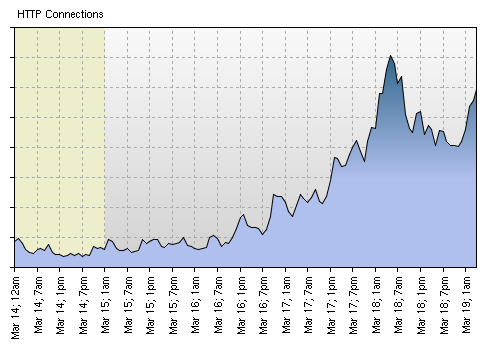
    MIX10 Site Connections

Mike, who’s a Microsoft technical evangelist, continues with a list of downloading options and a list of the top 20 sessions ranked by “overall satisfaction.”

<Return to section navigation list> 

Other Cloud Computing Platforms and Services

• Dana Gardner provides excerpts from his interview with two HP execs in a Burn the Silos and Jump Into the Data Pool article of 3/21/2010 for E-Commerce Times:

There's a realignment going on in data centers. Traditional technology silos are giving was to adaptive pools, shareable by any application. Let's put the benefits of converged infrastructure under the microscope and see how they can provide stepping stones to private cloud initiatives. Careful -- there are a lot of moving parts.

Improved data center productivity now appears to be a natural progression from converged infrastructure. Many enterprise data centers have embraced a shared service management model to some degree, and now converged infrastructure applies the shared service model more broadly to leverage modular system design and open standards, as well as to advance proven architectural frameworks.

The result is a realignment of traditional technology silos into adaptive pools that can be shared by any application, as well as optimized and managed as ongoing services. Under this model, resources are dynamically provisioned efficiently and automatically, gaining more business results productivity. This also helps rebalance IT spending away from a majority of spend on operations and more toward investments, innovations and business improvements.

This latest BriefingsDirect discussion explores the benefits of a converged infrastructure approach, and now how to better understand attaining a transformed data center environment. We'll see how converged infrastructure provides a stepping stone to private cloud initiatives. But as with any convergence, there are a lot of moving parts, including people, skills, processes, services, outsourcing options, and partner ecosystems.

We're here with two executives from HP (NYSE: HPQ) to delve deeply into converged infrastructure and to learn more about how to get started and deal with some of the complexity, as well as to know what to expect as payoff. Please welcome Doug Oathout, vice president, converged infrastructure at HP Storage, Servers and Networking; and John Bennett, worldwide director, Data Center Transformation Solutions at HP.

Dana Gardner is principal analyst at Interarbor Solutions.

Alex Williams analyzes The Virtualization Wars: Microsoft and Citrix v. VMware in this 3/20/2010 post:

RobotWatch this battle unfold. The virtualization wars are just getting started.

On one side we have Microsoft, which announced changes in its licensing structures this week. The change reflects an understanding that the customer wants full access to its virtualization platform and not be charged a tax for that right to access it on a PC, no matter if it is at work or in their home.

And in true fashion, Microsoft is on the attack, Citrix at its side, in a full on fight with VMware for the virtualization market.

On the VMware side, we see a company ready to move into Microsoft's customer base by offering more than virtualization as witnessed with its recent acquisition of Zimbra. VMWare is gearing up to tap into the Microsoft Exchange market by combining its virtualization technology with the Zimbra email platform. …

Alex continues with a “Microsoft Offers Some Flexibility” in licensing and related topics.

Mark Smith asserts HP Takes Technology Portfolio to the Clouds with New Growth Strategy in this 3/19/2010 post to the Ventana Research blog:

HP is a technology giant with annual revenue over $115 billion and an expanding technology portfolio that includes servers, storage, printers, computers and software; it also offers a broad range of outsourcing and consulting services. I attended the company’s 2010 global analyst summit in Boston to get an update from executives on its enterprise business portfolio of technology and services. The event was kicked off by Ann Livermore, executive vice president for enterprise business, a long-time leader in HP. HP has amassed a sizable portfolio of acquisitions, including EDS in 2008, and its pending deal to acquire 3Com will pair it up competitively against Cisco Systems. Now HP has intentions of being a player in cloud computing by providing technology that can easily be utilized virtually across the planet. It appears well poised for this task unless the likes of IBM can challenge HP directly.

HP’s multiyear strategy to lead enterprise computing in products, software and services is based on the convergence of technology infrastructure. HP is positioned to meet the next generation of corporate computing through what I call “computing as a service,” in which organizations can rely on HP to meet a range of needs without having to purchase and maintain in-house technology in their data centers. For this new generation of cloud computing solutions and services, HP has found customers in Verizon and government agencies such as the Defense Information Systems Agency, among others. This approach enables HP to provide its own technology to virtualize computing resources, and it has all the necessary technology, including management and automation software to support the process. HP also sees this as a unique opportunity to leverage its services organizations to develop and deploy new applications and services to operate within the cloud. It is still working out the mechanics of provisioning its computing power for its clients so they can scale their operations efficiently. HP also finds a significant business opportunity in application transformation and migration services when companies want to hand off hosting and management to service providers. …

Mark, who’s CEO & EVP Research for Ventana Research, continues his analysis and concludes:

The 2010 HP analyst summit was full of great insights about its current and future business. We sometimes underrate its role in the realm of technology innovation, which is a misperception, because it has taken steps to monetize on every aspect of its technology from printers to services to software. There are some areas where it is leaving of the field to IBM, Oracle and SAP to compete, for instance enterprise applications and middleware, but instead seeks to be the provider of the underlying computing platform such software requires. I would have liked to hear from CEO Mark Hurd, who is always up front and personal in his appearances, but I guess he does have a lot to do in managing a $100 billion plus business with over 300k employees. As this technology giant continues to march forward, I hope to see someone take its software business to the next level and be more evidently competitive against the other major providers in the market. HP definitely has plenty of upside as it strives to dominate its markets around the world.

Not to mention the recent HP-Microsoft agreement: Private Azure Clouds Float the $250 Million HP/Microsoft Agreement of 1/13/2010.

Sam Ramji presented Building Apigee for Multiple Clouds to Shlomo Swidler's panel "Writing Code for Many Clouds" at CloudConnect 2010:

At Sonoa, we have an enterprise product which we turned into a service called Apigee.  From the first, we needed to move beyond just being packaged as a VM and “deployable anywhere” to really living in the cloud.

This is what we’ve learned so far – some of which we anticipated and some of which we reacted to.  Build, deploy, and manage – of the three basic parts of running a service only deploy and manage really change.  The big difference is in operationalization of the system.

Most recently we realized that we needed to be HA across providers and get total control of our latency, so we are building a new datacenter on Rackspace as well.  This is a work in progress so I’ll be reporting from the front lines.

Finally, we’ve helped implement a multi-cloud architecture for ING which has taught us something about where multi-cloud services may be headed.

Sam discusses issues managing “The first cloud: EC2” and “The second cloud: Rackspace” and then asks “Is there an easier way?” …

For an infrastructure play like Apigee, we don’t think so.  Given our customer promise of near-zero and predictable latency we need as much control as possible.  For an application-level service play though, we think some parts can be easier.  We’re built on Sonoa technology that manages all of our cloud API traffic processing, as is ING, a financial service company that’s moving to cloud. Their challenge is elasticity in financial modeling – specifically the Monte Carlo simulation workload which is compute-intensive and highly intermittent in use of resource.  When you’re running the simulation, you need all the compute resource you can get.  When you’re not running a simulation, you need almost none. …

Rajkumar Buyya1, Rajiv Ranjan and Rodrigo N. Calheiros1 are co-authors of an InterCloud: Utility-Oriented Federation of Cloud Computing Environments for Scaling of Application Services whitepaper, which offers the following abstract:

Cloud computing providers have setup several data centers at different geographical locations over the Internet in order to optimally serve needs of their customers around the world. However, existing systems do not support mechanisms and policies for dynamically coordinating load distribution among different Cloud-based data centers in order to determine optimal location for hosting application services to achieve reasonable QoS levels. Further, the Cloud computing providers are unable to predict geographic distribution of users consuming their services, hence the load coordination must happen automatically, and distribution of services must change in response to changes in the load. To counter this problem, we advocate creation of federated Cloud computing environment (InterCloud) that facilitates just-in-time, opportunistic, and scalable provisioning of application services, consistently achieving QoS targets under variable workload, resource and network conditions. The overall goal is to create a computing environment that supports dynamic expansion or contraction of capabilities (VMs, services, storage, and database) for handling sudden variations in service demands.

This paper presents vision, challenges, and architectural elements of InterCloud for utility-oriented federation of Cloud computing environments. The proposed InterCloud environment supports scaling of applications across multiple vendor clouds. We have validated our approach by conducting a set of rigorous performance evaluation study using the CloudSim toolkit. The results demonstrate that federated Cloud computing model has immense potential as it offers significant performance gains as regards to response time and cost saving under dynamic workload scenarios. …

image

<Return to section navigation list>