Showing posts with label RSA. Show all posts

Monday, March 08, 2010

Windows Azure and Cloud Computing Posts for 3/8/2010+

Windows Azure, SQL Azure Database and related cloud computing topics now appear in this weekly series.

 
Note: This post is updated daily or more frequently, depending on the availability of new articles in the following sections:

To use the above links, first click the post’s title to display the single article you want to navigate.

Cloud Computing with the Windows Azure Platform published 9/21/2009. Order today from Amazon or Barnes & Noble (in stock.)

Read the detailed TOC here (PDF) and download the sample code here.

Discuss the book on its WROX P2P Forum.

See a short-form TOC, get links to live Azure sample projects, and read a detailed TOC of electronic-only chapters 12 and 13 here.

Wrox’s Web site manager posted on 9/29/2009 a lengthy excerpt from Chapter 4, “Scaling Azure Table and Blob Storage” here.

You can now download and save the following two online-only chapters in Microsoft Office Word 2003 *.doc format by FTP:

  • Chapter 12: “Managing SQL Azure Accounts and Databases”
  • Chapter 13: “Exploiting SQL Azure Database's Relational Features”

HTTP downloads of the two chapters are available from the book's Code Download page; these chapters will be updated for the January 4, 2010 commercial release in February 2010. 

Azure Blob, Table and Queue Services

No significant articles today.

<Return to section navigation list> 

SQL Azure Database (SADB, formerly SDS and SSDS)

T10 Media’s Azure Tools Start to Arrive post of 3/8/2010 to its new AzureSupport blog list a few commercial and open source tools for Windows Azure and SQL Azure:

A major impediment to Windows Azure’s adoption is the lack of tools to assist developers and admins, for example – DBA’s have to jump through hoops to back up a SQL Azure database as there are no backups tools are SQL Azure doesn’t yet have a native backup facility.

Over the past few months there has been a slow but steady trickle of new tools coming to the market. On the SQL Azure front,  Embarcadero’s dbArtisan for SQL Azure was released late 2009 and provides some basic functionality for working with SQL Azure databases (object management and editing) as well as some migration utilities. RedGate announced a beta for Azure enabled versions of  both their SQL Compare and SQL Data Compare tools (details here).  In should be noted that with SQL Server 2008 R2 many of the deficiencies of using SSMS to connect to SQL Azure databases (such as database objects not being visible) have been fixed and SSMS is now a useful tool for managing SQL Azure databases.

There are numerous open source and paid apps to interact with Azure storage such as Cerebrata’s Cloud Storage Studio or the Codeplex project Azure Storage Explorer .

For Windows Azure monitoring and diagnostics Cerebrata has announced a beta of Azure Diagnostics Manager which is a desktop WPF app which monitors event logs and as well as various performance metrics such as processor utilization etc.

With Mix just around the corner there should be some feature announcements from Microsoft at least (SQL Azure backup?) which will hopefully plug some of the gaps in the Azure platform.

I’m surprised the author missed these tools:

<Return to section navigation list> 

AppFabric: Access Control and Service Bus

Vittorio Bertocci’s Using the “Windows Identity Foundation and Windows Azure passive federation” lab with the February 2010 Windows Azure Tools post of 3/7/2010 shows you how to modify a setup cmdlet to accommodate the current (February 2010) Windows Azure Tools for Visual Studio 2008 version:

image

Quite a lot of you guys are trying to use the “Windows Identity Foundation and Windows Azure passive federation” lab (available in the Identity Developer Training Kit, Windows Azure Platform Training Kit and standalone) with the latest version of the Windows Azure Tools for Visual Studio. The dependency checker in the versions of the lab currently available, however, checks for the November release of the Windows Azure tool and gets quite upset if it doesn’t find it.

Eventually we are going to release new versions of the above with updated system requirements, but if you want to go through the lab TODAY with the latest Windows Azure bits all you need to do is changing one of the cmdlets in the setup:

Current CheckAzureToolsForVS.ps1 file:

$res1 = SearchUninstall -SearchFor 'Windows Azure Tools for Microsoft Visual Studio 2008 1.0*' -SearchVersion '1.0.21016.3' -UninstallKey 'HKLM:SOFTWARE\Wow6432Node\Microsoft\Windows\CurrentVersion\Uninstall\';

Fix to apply on CheckAzureToolsForVS.ps1 file:

$res1 = SearchUninstall -SearchFor 'Windows Azure Tools for Microsoft Visual Studio 2008 1.*' -SearchVersion '1.0.21016.3' -UninstallKey 'HKLM:SOFTWARE\Wow6432Node\Microsoft\Windows\CurrentVersion\Uninstall\';

Note, the requirement for VS2008 still stands.

The patterns & practices Team released the final PDF version of A Guide to Claims-Based Identity and Access Control on 3/2/2010:

Subtitled “Authentication and Authorization for Services and the Web,” the following description is from the books Foreward by Kim Cameron:

imageClaims-based identity means to control the digital experience and to use digital resources based on things that are said by one party about
another. A party can be a person, organization, government, Web site, Web service, or even a device. The very simplest example of a claim is
something that a party says about itself.

As the authors of this book point out, there is nothing new about the use of claims. As far back as the early days of mainframe computing, the operating system asked users for passwords and then passed each new application a “claim” about who was using it. But this world was a kind of “Garden of Eden” because applications didn’t question what they were told.

As systems became interconnected and more complicated, we needed ways to identify parties across multiple computers. One way to do this was for the parties that used applications on one computer to authenticate to the applications (and/or operating systems) that ran on the other computers. This mechanism is still widely used—for example, when logging on to a great number of Web sites.

However, this approach becomes unmanageable when you have many co-operating systems (as is the case, for example in the enterprise). Therefore, specialized services were invented that would register and authenticate users, and subsequently provide claims about them to interested applications. Some well-known examples are NTLM, Kerberos, Public Key Infrastructure (PKI), and the Security Assertion Markup Language (SAML).

If systems that use claims have been around for so long, how can “claims-based computing” be new or important? The answer is a variant of the old adage that “All tables have legs, but not all legs have tables.” The claims-based model embraces and subsumes the capabilities of all the systems that have existed to date, but it also allows many new things to be accomplished. This book gives a great sense of the resultant opportunities.

Links:

<Return to section navigation list>

Live Windows Azure Apps, APIs, Tools and Test Harnesses

T10 Media’s Getting Started with Windows Azure Diagnostics and Monitoring post of 8/8/2010 to its new AzureSupport blog begins:

The Windows Azure diagnostics service runs side-by-side with your role instance and collects diagnostics data as dictated by the configuration. The diagnostics service saves the data to your Windows Azure storage service if it is configured to do so. The diagnostics service can also be communicated with remotely from on-premise apps (a good example of this is the Windows Azure Diagnostics Manager). The Azure diagnostics service supports monitoring and logging of the following information from the Azure service:

  • Windows Azure logs: The application logs dumped from an application which can be any messages emitted by the app.
  • Diagnostic monitor logs: Logs about the running of the diagnostics service.
  • Windows performance counters: A range of performance metrics such as processor utilization, response times etc
  • Windows event logs:  Logs generated on the instance where the role instance is running.
  • IIS logs and failed request traces: IIS logs and IIS failed request traces generated by a Web role instance.
  • Application crash dumps: Crash dumps generated upon an app crash.

To gather diagnostics in Windows Azure there are two steps – configuration and management. First you will need to configure the diagnostics service with the data types you wish to collect. Then you will need to use the diagnostics management API which comes with the Windows Azure SDK you can perform regularly scheduled or on-demand transfers of the diagnostics data from the role instances to a Windows Azure storage account. The diagnostics management API also allows for changing the configuration of an already running diagnostics service.

The post continues with

    • Logging
    • Configuring the Trace Listener
    • Defining a Storage Location for the Diagnostics Service
    • Starting the Windows Azure Diagnostics Service

sections.

Steve Nagy’s Windows Azure Development Deep Dive: Working With Configuration post of 3/7/2010 begins a discussion of ServiceDefinition.csdef and Service Configuration.cscfg files with:

One of the things you have to consider in any application is configuration. In windows and web forms we have *.config files to help configure our application prior to start. They are a useful place to store things like provider configuration, IOC container configuration, connection strings, service end points, etc. Let’s face it – we use configuration files a lot.

In this article I will discuss the different types of configuration available to you, how they can be leveraged in your application, and how configuration items can be changed at runtime without causing your application roles to restart.

The Problems With Configuration in the Cloud

In Windows Azure applications, configuration can work exactly the same as standard .Net applications. If you have a web role, then you have a web.config. And if you have a worker role, you get an app.config. This allows you to provide configuration information to your role when it starts.

But what about configuration values you want to change after your app is deployed and running? It certainly is a lot harder to get in and change a few angle brackets in your web.config after it is deployed to production in the cloud. Do you really want to have to upload a whole new version of the app package with the new web.config file in it?

Or what about being able to change configuration aspects of all your running instances in one go, and not having to stop them from running to do so? Why should a configuration change necessitate a restart, such as is needed with web.config and app.config files?

In Windows Azure we have a new method of configuring our roles that gives us flexibility and consistency in our applications.

Steve continues with detailed explanations of the following topics:

    • Setting Configuration Values
    • Changing Configuration Values At Runtime In Azure
    • Simple Handling Of Configuration Values In Code
    • Handling Storage Connection Strings In Code
    • The Catch With Using Configuration Methods In The Storage API
    • How Can I Make My Application Utilise This Abstraction
    • Handling Configuration Changes At Runtime

SpiveyWorks claims “SpiveyWorks Notes in combination with the Windows Azure platform helps enable customers to use their computer or mobile phone to take and share mobile notes easier and faster” in its SpiveyWorks Becomes a "Front Runner" With the Release of its Newest Application, SpiveyWorks Notes press release of 3/5/2010:

SpiveyWorks today announced it will launch a new application using the Windows Azure Platform. SpiveyWorks Notes in combination with the Windows Azure platform helps enable customers to use their computer or mobile phone to take and share mobile notes easier and faster. The Windows Azure platform, Microsoft’s cloud services platform, provides SpiveyWorks with the ability to build, manage, and deploy cloud based applications.

SpiveyWorks Notes logo

“Thru the technical and marketing support provided by the Front Runner program, we are excited to see the innovative solutions built on the Windows Azure platform by the ISV community,” said Doug Hauger, general manager for Windows Azure Microsoft Corp. “The companies who choose to be a part of the Front Runner program show initiative and technological advancement in their respective industries.”

“Windows Azure platform provides greater choice and flexibility in how we develop and deploy web-based applications to our mobile worker customers, both on-premises or in the cloud,” said Michael Spivey, CEO of SpiveyWorks.

SpiveyWorks Notes automates critical processes such as mobile worker information systems that support decision-making on the go, conveniently using devices commonly held by today’s mobile worker. Windows Azure was a critical component of the platform, providing the reliability and scalability our customers demanded. …

John Mokkosian-Kane and Daniel Hsu demonstrate Event-Driven Architecture in the Clouds with Windows Azure in this 2/5/2010 post to The Code Project:

The goal of this article is to simplify Windows Azure and event-driven architecture by walking through the process of building a .NET event driven system in the clouds. Let's start with some basic and boring definitions:

  • Event-driven architecture: "A pattern promoting the production, detection, consumption of, and reaction to events." - Wikipedia
  • Windows Azure: "A cloud services Operating System that serves as the development, service hosting, and service management environment for the Windows Azure platform. Windows Azure provides developers with on-demand compute and storage to host, scale, and manage web applications on the internet through Microsoft® datacenters." - Microsoft. …

To demonstrate Azure and EDA beyond text book definitions, this article will show you how to build a flight delay management system for all US airports in clouds. The format of this article is intended to be similar to a hands on lab, walking you through each step required to develop and deploy an application to the clouds. This flight delay management system will be built with a mix of technologies including SQL 2008 Azure, Visual Studio 2010, Azure Queue Service, Azure Worker/Web Roles, Silverlight 3, Twitter SDK, and Microsoft Bing mapping. And, while the implementation of this article is based on a flight delay system, the concepts can be leveraged to build IT systems in the clouds across functional domains.

You might find Gregor Hohpe’s Programming Without a Call Stack – Event-driven Architectures white paper, which defines Complex Event Processing (CEP), and Tibco’s Complex Event Processing blog to be of interest also.

<Return to section navigation list> 

Windows Azure Infrastructure

Sam Johnston (@samj) claims the Cloud Computing Interoperability Forum (CCIF) is dead and doghoused in this 3/8/2010 post:

While I wait for my latest post to the Cloud Computing Interoperability Forum (CCIF) to be vetted for anything negative about Enomaly I thought I'd take a few moments to give you a quick update in the cloud standards debacle. You probably remember last year's scandal where Reuven Cohen was evicted (along with myself and an unknown number of other bloggers) from his ownthe cloud-computing Google Group by his own employee, "Director of Research and Development" Khazret Sapenov. Reuven implies that he was evicted for firing this guy and as we still haven't heard the full story he must be still paying severance.

Anyway Khaz subsequently cleared up any doubt about their intentions for the list by [ab]using it to boot strap the Cloud Slam '09 virtual conference which, at around 50 bucks a 'virtual' seat (in addition to $10k extracted from sponsors AMD & Data Synapse) is still a pretty penny for an event largely organised and delivered by others. Congratulations for pulling off perhaps the biggest cloud computing related scam of the last year (I don't include Dell's trademark attempt because they didn't get away with it, and neither will Psion with "netbook" if I have any say in it). (see update 4 below)

Meanwhile some six months ago, upset about the loss of his prized possession and unfazed by the community's need for a clear communication channel (which is still under-served to this day) Reuven announced the Cloud Computing Interoperability Forum, where he carries the self appointed title of "Instigator" (the same title he carries for the CloudCamps which are also largely organised by others like Dave Nielsen and Sam Charrington). The group, which has the lofty goal of "[enabling] interoperable enterprise-class cloud computing platforms" (though its mission is now largely concealed by puffery) has so far produced nothing but noise and there's no reason to believe it's going to change any time soon. …

Sam, who’s a Technical Program Manager at Google stationed in the Zurich, Switzerland area, continues with more lengthy arguments supporting his assertion.

B. V. Kumar asserts “Microsoft's Azure would enable companies in India to strengthen their IT roadmap by including the cloud as a core component of their strategy” in his Windows Azure available in India post of 3/8/2010:

Microsoft India today announced the commercial availability of the Windows Azure Platform, an Internet-scale cloud services platform hosted in Microsoft’s datacentres.
Today’s move would enable companies in India to strengthen their IT roadmap by including the cloud as a core component of their strategy to drive higher productivity and efficiencies, said a press release.

Rajan Anandan, managing director, Microsoft India said, “No other company matches the flexibility and the power of choice that Microsoft provides to customers —to select how they deploy software either on premise, in the cloud, or a combination of both, and, of course, the ability to access  technology across multiple screens – viz the phone, PC and Internet.”

“We believe that Microsoft’s initiative and leadership in cloud services will be beneficial to customers, partners and developers as we architect our solutions to optimize for cloud and on-premises solutions,” he added. …

James Watters asks Cloud APIs, Vital and Strategic? Or Geeky, Unused and Anemic? in this 3/7/2010 post:

This week no fewer than four people I respect in the cloud ecosystem cautioned me not to get to enraptured with cloud APIs. The argument was similar across their critiques: lots of talk about them, very little buying through them, they are interesting for geeks and obscure outside that circle.

I was shocked--but my shock in itself was alarming to me. Am I over rotated on the broad platform characteristics of cloud computing? Are cloud infrastructure services more valuable as a complete resource management applications than as modular horizontal platforms?

The argument against API centrality, as far as I can surmise goes something like this:

“Chill on the API love fest man. What really matters are the core functions of resource management, provisioning and user management. What's really new about the cloud isn't an API, we've had those, its the standardization and control of server and network resources en mass. Also, wake up, most people are going to consume whatever prescriptive GUI framework the cloud provider puts forth and be happy. Customers of XYZ big hosters are going to pay far more for a portal experience than an API.”

Here is my critique back:

  1. A buyer, is not always just a buyer. Say 90% of cloud resource 'buyers' use a non API method of consuming resources. This doesn't refute the importance of the API. See reason #2.
  2. Innovation happens elsewhere. Twitter knows this well. Do you use Twitter or do you use Tweetdeck on the Twitter platform? Assuming you follow the logic of the resource, network and user management argument above--it actually should create more incentives to open up an ecosystem of potential consumption and integration methods. The cost of creativity gap between a large organization, and a lean entrepreneur to create value ad above the core provisioning management system is vastly different. Twitter is a relatively simple distributed messaging system; the possibilities in infrastructure and data services are even greater. 
  3. Heroku, Engine Yard, JungleDisk, Storsimple; these are not just alternative management and control GUI's, they fundamentally ad[d] another layer of real value. They are early examples of #2--and these are very early days. 
  4. If you are really pursuing a managed hosting offering where the customer is more interested in the service relationship than the platform automation and compatibility the API may definitely be less relevant. The managed hosting marketing is also orders of magnitude larger than the current cloud infrastructure market; however, none of that means the attributes of the managed hosting market = the cloud infrastructure market. They are juxtaposed but separate along key strategic axes. 
  5. Smart buyers with long term vision care about the API story for all of the above reasons. It is a necessary but not sufficient aspect of the offering to them--but again bad logic to confuse sufficiency with necessity.

The question behind the question has to do with the strategic nature of cloud infrastructure services in the long term. Are they a corner case deployment, a hackers liberation sandbox with some interesting but limited mutations, or the fundamental platform of the future?

<Return to section navigation list> 

Cloud Security and Governance

Lori MacVittie’s The Corollary to Hoff’s Law of 3/8/2010 begins:

access-control“Security” concerns continue to top every cloud computing related survey. This could be because, well, CIOs and organizations in general are concerned about security. It could be because the broader question of control over the infrastructure – including security – is never proffered as a reason for reluctance to jump into the fray known as cloud computing.

  • Forty-nine percent of survey respondents from enterprises and 51 percent from small and medium-size businesses cited security and privacy concerns as their top reason for not using cloud computing. – Survey: Security Concerns Hinder Cloud Computing Adoption, NetCentric Security, December 2009
  • In a survey of 312 IT professionals, Unisys found that just over half of them cited security and data privacy as the key concerns around cloud computing. Security Key Concern in Cloud Computing, Unisys Survey Finds
  • According to Forrester Research’s Cloud Computing study 2009, about 44 per cent of large enterprises are interested in building an internal cloud. “Enterprises are more attracted to private cloud compared to public, due to security concerns about mission critical applications and data,” Kumar [Sushil Kumar, Oracle’s vice president of Product Strategy and Business Development System Management Product Group] noted. -- And finally Oracle is on Cloud

Interestingly, IDC’s latest Cloud Survey (December 2009) actually seems to show that broader “control” issues are coming to light. 76% of respondents indicated that “not enough ability to customise” was a challenge in their quest to adopt cloud computing models.

Visibility, while also a concern, can also be a side-effect of control. If you have control over the infrastructure you also have visibility. It could be argued that providers could enable the means by which customers could have visibility into infrastructure, especially the network, by exposing reporting but the truth is most network infrastructure solutions are not capable of providing the isolation of data required (they are not inherently mutli-tenant) and thus it’s not as easy as it might sound. …

Lori concludes with a reference to Chris (@Beaker) “Hoff’s Law:”

[W]e need to stop portraying cloud computing environments as though they are sieves. Providers certainly do have security measures in place, whether we know what they are or not. It’s not as if they’re running out of a basement, after all, and they understand the need for security not just for their customers, but to protect their own infrastructure and investments. In that respect Hoff’s Law holds true: the security of applications you place in the cloud has just as much to do with your security practices as it does the providers’.

*Rational Survivability, December 2009, “Cloud Computing Public Service Announcement – Please Read

Chris Hoff discusses collaboration, cloud, mobility, virtualization, et al. with Cisco’s Tom Gillis in this Chattin’ With the Boss: “Securing the Network” (Waiting For the Jet Pack) video segment released on 3/7/2010:

At theRSA security conference last week I spent some time with Tom Gillis on a live uStream video titled “Securing the Network.”

Tom happens to be (as he points out during a rather funny interlude) my boss’ boss — he’s the VP and GM of Cisco’s STBU (Security Technology Business Unit.)

It’s an interesting discussion (albeit with some self-serving Cisco tidbits) surrounding how collaboration, cloud, mobility, virtualization, video, the consumerizaton of IT and, um, jet packs are changing the network and how we secure it.

Direct link [to the video] here.

Dave Kearns asserts “Microsoft will provide core portions of the U-Prove intellectual property under the Open Specification Promise, and release open source software development kits in C# and Java editions” in his U-Prove general availability announced Network Security Alert of 3/5/2010 for NetworkWorld’s Security blog:

Two years ago, when Microsoft acquired Credentica and the technology called "U-Prove" (which uses cryptography and multi-party privacy features to facilitate "minimal disclosure" so a user can reveal only the bits of information about themselves they want to while protecting their privacy), Microsoft's Identity Architect Kim Cameron promised that it would be made available for all platforms.

In his words, "it is elementary … that identity technology must work across boundaries, platforms and vendors." But he cautioned: "That doesn't mean it is trivial to figure out the best legal mechanisms for making the intellectual property and even the code available to the ecosystem. Lawyers are needed, and it takes a while." It, in fact, took two years.

But last week, at the RSA Security Conference in San Francisco, Scott Charney, corporate vice president of Microsoft's Trustworthy Computing Group, announced the general availability of U-Prove -- and not just in Microsoft products.

Charney, in a keynote address to the conference, explained that identity solutions that provide more secure and private access to both on-site and cloud applications are key to enabling a safer, more trusted enterprise and Internet. And as part of that effort, Microsoft was releasing a community technology preview of the U-Prove technology. In order to encourage broad community evaluation and input, Charney also announced that Microsoft is providing core portions of the U-Prove intellectual property under the Open Specification Promise, as well as releasing open source software development kits in C# and Java editions.

When Microsoft acquired Credentica I said: "The elegance of the U-Prove technology -- and the iron-clad security it gives --  should be the final nudge Cardspace needs to set it on the road to being the dominant SSO technology, first on the Web and then later in the enterprise. The key factor is the privacy issue -- U-Prove makes transactions unlinkable on any level by any party -- even the SSO identity provider! There is nothing else in the SSO space that even comes close." This is as true today as it was then.

U-Prove, when embedded within identity exchanging services, enables a degree of control, privacy and that "warm, fuzzy feeling" that nothing bad will happen to your data which is not now, nor ever has been, available for transactions, resource security and general data sharing. This is big.

Microsoft U-Prove press release, Microsoft Outlines Progress Toward a Safer, More Trusted Internet of 3/2/2010, and U-Prove CTP site on Microsoft Connect.

The following software components are available as part of the U-Prove CTP:

Dave Kearns is a consultant and editor of IdM, the Journal of Identity Management.

<Return to section navigation list> 

Cloud Computing Events

Gartner research VP Frances Karamouzis will host an Evaluate Cloud Service Providers with Confidence webinar on 3/10/2010 at 9:00 AM PST:

This presentation is focused on addressing the broad category of Cloud Service Providers. Gartner will provide a overview of how Cloud Service Providers are being defined and how they different from traditional providers of outsourcing or products. And more importantly, what are they offering that is different, new and seeks to solve business problems for the enterprise.  This session will provide an overview of these areas and begin the discussion of how do clients develop the business case for certain cloud services offerings.

What You Will Learn

Gartner analysts will discuss the following topics with you:

  • What is a cloud service provider and how does it differ from traditional outsourcing providers?
  • How will the approaches to evaluate and select among these providers differ?
  • How does the business case analysis differ?

Register here.

BrightTALK offers a virtual Next Generation Data Center Summit on 3/17/2010:

As the heart of business IT operations and data processing, next generation data centers are creating incredible levels of efficiency, flexibility and reliability. At this summit, leading industry experts, analysts, and end-users will discuss the latest innovations, best practices, and solutions in IT infrastructure and data center management.

The summit includes the following presentations:

You will be able to attend any or all of the presentations in this complimentary summit, submit real-time questions to presenters and vote in audience polls. If you are unable to attend the webcasts live, you can also view them afterward on-demand.

MIX10 will feature 11 Azure-related sessions on 3/15 through 3/17/2010 at the Mandalay Bay Hotel & Casino in Las Vegas, NV:

  1. Cloud Computing Economies of Scale by James Hamilton in Breakers L on Monday 11:30 AM
  2. Storm Clouds: What to Consider About Privacy Before Writing a Line of Code by Jonathan Zuck in Lagoon B on Monday at 3:30 PM
  3. Lap around the Windows Azure Platform by Steve Marx in Breakers L on Monday at 3:30 PM
  4. Copyright: A Cloudy Subject by Jonathan Zuck in Lagoon B on Monday at 4:05 PM
  5. Building and Deploying Windows Azure-Based Applications with Microsoft Visual Studio 2010 by Jim Nakashima in Breakers L on Tuesday at 11:00 AM
  6. Microsoft Project Code Name "Dallas": Data For Your Apps by Moe Khosravy in Breakers L on Tuesday at 1:30 PM
  7. Using Ruby on Rails to Build Windows Azure Applications by Sriram Krishnan in Breakers L on Tuesday at 4:30 PM
  8. Building Platforms and Applications for the Real-Time Web with Chris Saad, Brett Slatkin, Ari Steinberg, Ryan Sarver, Lili Cheng, Dare Obasanjo in Breakers H on Wednesday at 9:00 AM
  9. Building Web Applications with Windows Azure Storage by Brad Calder in Breakers L on Wednesday at 10:30 AM
  10. Building Web Applications with Microsoft SQL Azure by David Robinson in Breakers L on Wednesday at 12:00 PM
  11. Connecting Your Applications in the Cloud with Windows Azure AppFabric by Clemens Vasters in Breakers L on Wednesday at 1:30 PM

Microsoft TechDays 2010 Belgium on 3/30, 3/31 and 4/1/2010 at Metropolis, Antwerp, Belgium will include four Azure-related presentations:

  • Sumit Mehrota: A Lap Around the Windows Azure Platform (3/31/2010, 14:30 – 15:45)
  • Sumit Mehrota: Deepdive into Windows Azure (4/1/2010, 10:45 – 12:00)
  • Maarten Balliauw: Put Your Existing Applications in the Cloud (4/1/2010, 13:00 – 14:15)

Joe McKendrick will conduct a Webinar entitiled The Economics of Cloud Computing for ebizQ on 4/7/2010 at 7:00 AM PST:

The economics of cloud computing can look enormously attractive, especially when weighing the costs of storage or processing at a few cents per instance or gigabyte, versus the tens of thousands of dollars in up-front investments required for on-site solutions. Cloud providers can deliver economies of scale not available to individual enterprises. But over the long run, do these huge savings hold up or collapse for enterprises? What about the costs associated with integration, configuration, data deduplication, and monitoring? Also, do enterprises need to look beyond cost and consider other potential benefits of cloud computing, such as the ability to focus resources on the business, versus IT maintenance? What about costs related to loss of control and customization? Or potential loss of competitive advantage that may be inherent in on-site, customized systems? This session will examine the economic pros and cons of on-demand versus on-site computing, and where these approaches may or may not work.
This session will cover the following:

  • Making the business case for cloud
  • When does it make economic and business sense to migrate an application to a cloud provider?
  • Potential hidden costs associated with cloud computing
  • Chargebacks and other revenue models for internal cloud service providers
  • Determining return on investment for cloud implementations

Forrester Research announces it’s IT Forum 2010, which runs from 5/26 to 5/28/2010 at the Palazzo Hotel in Las Vegas, NV:

At this Event, we’ll help each of the roles we serve lead the shift from IT to BT, but we’ll do so in pragmatic, no-nonsense terms. We’ll break the transformation into five interrelated efforts:

  • Connect people more fluidly to drive innovation. You serve a more socially oriented, device-enabled population of both information workers and customers. You want to empower both groups without losing control of costs or hurting productivity.
  • Infuse business processes with business insight. You support structured business processes but lose control as they bump heads with a multitude of unstructured processes. You want to connect both forms of process to actionable data, but you struggle with data quality and silos.
  • Simplify always and everywhere. You have the tools to be more agile, but you face a swamp of software complexity and unnecessary functionality. You want technologies, architectures, and management processes that are more fit-to-purpose.
  • Deliver services, not assets. You want to speak in terms that the business understands, but you find your staff confined to assets and technologies. You want to shift more delivery to balance-sheet-friendly models but struggle to work through vendor or legacy icebergs.
  • Create new, differentiated business capabilities. Underpinning all of these efforts, you want to link every technology thought — from architecture to infrastructure to communities — to new business capabilities valued by your enterprise.

Microsoft is a sponsor of the event.

<Return to section navigation list> 
Other Cloud Computing Platforms and Services

Colin Clark’s Cloud Event Processing: CEP in the Cloud post of 3/7/2010 describes Complex Event Processing of Twitter messages with MapReduce technology:

Over the past few weeks, I’ve implemented map/reduce using techniques commonly found in Complex Event Processing.  Here’s a summary of what was involved, and what tools would make such a deployment easier.

Getting the Data
One of the first tasks accomplished was the creation of an OnRamp – we use OnRamps to get data into our cloud for processing.  The specific OnRamp used in this learning exercise subscribed to Twitter and fed the resulting JSON objects onto the service bus, RabbitMQ in this case.  We had to correctly configure RabbitMQ for this, and the OnRamp needed to be specifically aware of and implement semantics required to publish on this bus.  It would be easier and more portable if this were abstracted in some type of OnRamp api; we had abstracted this at Kaskad.  In Korrelera, the bus didn’t matter – we could just as easily use direct sockets, JMS, Tibco or 29West.  The OnRamp didn’t know, and didn’t care.  In our TwitYourl example, there’s no way to monitor or manage the OnRamp other than tailing its output and visually inspecting it.  There is no central management or operations console.

Definition of Services
Although we’ve used Map/Reduce as our first example, the topology doesn’t really matter.  What matters is that we created a number of services and then deployed them.  In our small example, we wrote a RuleBot that performed the Map function in Map/Reduce.  This RuleBot listen for Tweet JSON objects, pulled them apart, found the information we were interested in, chunked it, and then fed it back onto the service bus. Another RuleBot performed the Reduce function – events were pumped into the Esper open source CEP engine where the could then be queried, Again, the RuleBots had to be aware the underlying bus’s semantics and could not be managed or monitored in our TwitYourl example.

Deployment to the Cloud
All of this had to then be deployed to the cloud – there are two main components to this.  First, we assumed that each node in the cloud was configured correctly.  This had to be done by hand – it would have been much easier to have an image that contained everything we needed from an infrastructure, or plumbing, point of view that could have been deployed to any number of servers via point and click.  Secondly, the services themselves needed to be deployed, and as I’ve already pointed out, those services had to be aware of the bus, could not be managed, and could not be monitored.  All of this had to be done by hand.  And log files, or console windows had to be examined both operationally and to examine the fruits of our labors. …

Colin concludes:

What’s Next?

I’m going to outline the requirements, at a high level, of what this command and control architecture looks like, and we’re going to re-deploy TwitYourl using this new approach.  By doing this, we will be able to compare the ‘old’ way of deploying 1st generation CEP based solutions, which are designed to scale vertically on multiprocessor based single machines, and our new Cloud Event Processing approach which is designed to scale not only vertically, but also horizontally, running on many more machines either in a public, private, or hybrid cloud.  And then we’ll talk about a much better way to look at output than by monitoring a console or tailing a log file!

The SQL Cloud Data Programmability Team’s Reactive Extensions to .NET 4 (Rx 4) release candidate, which Bart De Smet announced in his New drop of the Reactive Extensions for .NET (Rx) available post of 3/5/2010, adapts LINQ to CEP with new IObservable(T) and IObserver(T) intefaces, which correspond to their familiar IEnumerable(T) and IEnumerator(T) counterparts. I’ll begin reporting Azure-related CEP and Rx articles shortly.

In the meantime, see John Mokkosian-Kane and Daniel Hsu’s Event-Driven Architecture in the Clouds with Windows Azure post at the end of the Live Windows Azure Apps, APIs, Tools and Test Harnesses section.

Paessler AG uses its PRTG Network Monitor to monitor the performance of Amazon EC2 US East, EC2 US West, EC2 EU West, Amazon S3, GoGrid, NewServers, Op Source, and Cloud CDNs with results available at the CloudClimate (Beta) site:

CloudClimate displays monitoring results from a globally distributed installation of PRTG Network Monitor, a network monitoring software from Paessler AG. PRTG works with one core server installation and a number of remote probes used to measure system performance and to remotely monitor performance of network services.

Locations of CloudClimate Systems

The remote probes for CloudClimate are installed on virtual systems in selected hosting clouds:

To provide an additional perspective (without breaking the bank) we are running a number of probes on selected low-cost VPS servers around the globe, hosted by:

<Return to section navigation list> 

Saturday, March 06, 2010

Windows Azure and Cloud Computing Posts for 3/4/2010+

Windows Azure, SQL Azure Database and related cloud computing topics now appear in this weekly series.

 
• Update 3/6/2010: Steve Ballmer’s UofW presentation; Tim Anderson’s analysis of Steve’s speech; Lin Langit’s SQL Azure slides; Lori MacVittie on Cloud Security with Infrastructure 2.0; Zoli Erdos and the Under the Radar event; Brent Stineman updates his Azure Service Configuration post; Mike Kelly explains A PowerShell Cmdlet for Managing Windows Azure Diagnostics; Matthias Jauernig describes his live Azure Rating Stress Simulator application; ebizQ announces Cloud QCamp 2010; Shuttervoice.com reports Largest Image Update For Bing Maps in live Azure World Tour app; and Vittorio Bertocci announces a series of Windows Identity Foundation Workshops.

Note: This post is updated daily or more frequently, depending on the availability of new articles in the following sections:

To use the above links, first click the post’s title to display the single article you want to navigate.

Cloud Computing with the Windows Azure Platform published 9/21/2009. Order today from Amazon or Barnes & Noble (in stock.)

Read the detailed TOC here (PDF) and download the sample code here.

Discuss the book on its WROX P2P Forum.

See a short-form TOC, get links to live Azure sample projects, and read a detailed TOC of electronic-only chapters 12 and 13 here.

Wrox’s Web site manager posted on 9/29/2009 a lengthy excerpt from Chapter 4, “Scaling Azure Table and Blob Storage” here.

You can now download and save the following two online-only chapters in Microsoft Office Word 2003 *.doc format by FTP:

  • Chapter 12: “Managing SQL Azure Accounts and Databases”
  • Chapter 13: “Exploiting SQL Azure Database's Relational Features”

HTTP downloads of the two chapters are available from the book's Code Download page; these chapters will be updated for the January 4, 2010 commercial release in February 2010. 

Azure Blob, Table and Queue Services

See K. Scott Morrison’s REST Security Does Exist—You Just Need To Apply It post of 3/4/2010 in the Cloud Security and Governance section.

<Return to section navigation list> 

SQL Azure Database (SADB, formerly SDS and SSDS)

See Lynn Langit’s SQL Azure slide deck from the ‘Day of Azure’ event in San Diego on 3/6/2010 in the Cloud Computing Events section.

The SQL Azure Team posted on 3/5/2010 a job opening for a Development Lead, Senior Job to build “mission critical database APIs” for Linux and PHP connectivity to SQL Server and SQL Azure:

We are building a team in SQL Connectivity that will focus on providing PHP and Linux based secure, reliable and scalable connectivity libraries to exchange data with the SQL Server. This team is responsible for broadening our developer base in these strategic areas and ensuring that they will have the full power, performance and scalability necessary to build their applications against SQL Server.

If owning components that are required for the success of ISVs, Enterprises, MS Office, Sql Services, SQL Azure ; solving complex technical problems; working on a team that has high visibility and a team that cares to listen to your ideas; are the type of things that get you excited, then this is the position for you.

We are seeking a highly motivated Senior Development Lead who is passionate about working on mission critical database API's. The ideal candidate will have 2-3 years of dev lead experience, strong Linux and/or PHP experience, a strong track record as a manager and mentor, the ability to collaborate and drive consensus across teams, and the ability to go deep in understanding complex subjects across all our SQL Server data access stacks. The technical ownership opportunities include the ability to drive long term connectivity solutions for SQL Server and SQL Azure.

Ryan Dunn explains Calculating the Size of Your SQL Azure Database  in this 3/5/2010 post:

In Episode 3 of Cloud Cover, I mentioned the tip of the week was how to measure your database size in SQL Azure.  Here is the exact queries you can run to do it:

select
      sum(reserved_page_count) * 8.0 / 1024
from
      sys.dm_db_partition_stats
GO

select
      sys.objects.name, sum(reserved_page_count) * 8.0 / 1024
from
      sys.dm_db_partition_stats, sys.objects
where
      sys.dm_db_partition_stats.object_id = sys.objects.object_id

group by sys.objects.name

The first one will give you the size of your database in MB and the second one will do the same, but break it out for each object in your database.

Hat tip to David Robinson and Tony Petrossian on the SQL Azure team for the query.

Glenn Barry delivers More SQL Azure Samples with a very long T-SQL script in this 3/4/2010 post:

I have been playing around some more with SQL Azure in order to get ready for an upcoming presentation, so I thought I would share some of the T-SQL commands in the script below. I have a partial copy of the sample AdventureWorksLT2008R2 database installed on my SQL Azure logical “server” in the Southern US data center before this demo starts. You need at least the November CTP of SQL Server 2008 R2, in order to talk to SQL Azure with SSMS.

I have mainly just trying different commands to see what works and what does not work in SQL Azure, so I hope you find this interesting and useful.

You’ll need the AdventureWorksLT2008R2 database running in SQL Azure to take full advantage of the script. See my Using the SQL Azure Migration Wizard v3.1.3/3.1.4 with the AdventureWorksLT2008R2 Sample Database post of 1/23/2010 for the quick and easy way to upload the database schema and data.

Lori MacVittie’s The IP Address - Identity Disconnect post of 3/4/2010 asserts “The advent of virtualization brought about awareness of the need to decouple applications from IP addresses. The same holds true on the client side – perhaps even more so than in the data center” and contests the foundation of SQL Azure’s firewall:

unknown_user I could quote The Prisoner, but that would be so cliché, wouldn’t it? Instead, let me ask a question: just which IP address am I? Am I the one associated with the gateway that proxies for my mobile phone web access? Or am I the one that’s currently assigned to my laptop – the one that will change tomorrow because today I am in California and tomorrow I’ll be home? Or am I the one assigned to me when I’m connected via an SSL VPN to corporate headquarters?

If you’re tying identity to IP addresses then you’d better be a psychiatrist in addition to your day job because most users have multiple IP address disorder.

IP addresses are often utilized as part of an identification process. After all, a web application needs some way to identify a user that’s not supplied by the user. There’s a level of trust inherent in the IP address that doesn’t exist with my name or any other user-supplied piece of data because, well, it’s user supplied. An IP address is assigned or handed-out dynamically by what is an unemotional, uninvolved technical process that does not generally attempt to deceive, dissemble, or trick anyone with the data. An IP address is simply a number. …

Lori continues with an analysis of the need for user context:

Cookies. Unique names. Device types. Browser. Tokens. Any combination thereof. In other words, user context. It’s not that we need to stop using IP addresses altogether, but we do need to stop using them as an authoritative source on their own. They are still, certainly, part of the equation but it’s not an idempotent one and especially when used for security purposes it should be just one more piece of information used to make the determination to deny, allow, or grade access to application and network resources. …

Dennis Forbes recommends Getting Real about NoSQL and the SQL-Isn't-Scalable Lie in this 3/2/2010 essay:

Getting Defensive

I work in the financial industry. RDBMS’ and the Structured Query Language (SQL) can be found at the nucleus of most of our solutions.

The same was true when I worked in the insurance, telecommunication, and power generation industries.

So it piqued my interest when a peer recently forwarded an article titled “The end of SQL and relational databases”, adding the subject line “We’re living in the past”.

[Though as Michael Stonebraker points out, SQL the query language actually has remarkably little to actually to do with the debate. It would be more clearly called NoACID]

That series focuses on NoSQL as the challenger to the throne.  It isn’t alone as the past year has yielded a bountiful crop of articles and blog entries declaring the imminent death of the decrepit relational database at the hands of this new innovation.

Most get posted with incendiary, absolute statements against the RDBMS.

“The ACIDy, Transactional, RDBMS doesn’t scale, and it needs to be relegated to the proper dustbin before it does any more damage to engineers trying to write scalable software.”

And they usually see later edits that blunt the original euphoria.

"Postnote: This isn’t about a complete death of the RDBMS. Just the death of the idea that it’s a tool meant for all your structured data storage needs.”

Indeed. …

Dennis continues his argument under the following topics:

    • So what is scalability, anyways? …
    • When Money Is No Object …
    • Artificially Limited Scalability …
    • The Needs of a Bank Aren’t Universal …

And concludes

    • SQL is Scalable and NoSQL Isn’t For Everyone …

A convincing essay, IMO. Be sure to read the comments.

Dennis is a Toronto-based software architect focused primarily on the .NET and SQL Server worlds.

Jeff Darcy pushes back against Dennis in his Getting Silly About NoSQL post of 3/3/2010:

… I was going to try to be polite, until I saw your slam against All Things Distributed as a NoSQL advocacy site. What rubbish. Vogels and company know more about scalability than just about anyone, and more about using the right tool for the right job – which is why they provide RDS as well as SimpleDB. Even if that weren’t the case, what you’re engaging in is mere ad hominem. Vogels’s definition of scalability is right or wrong on the merits, not based on who he is or what other opinions you attribute to him. Might as well dismiss all of *your* definitions and claims based on your being an RDBMS advocate. As it happens, I was making Oracle scale before there was a NoSQL, before there was even RAC (it was OPS back then), and from then until now I’ve always used a very similar definition of scalability: maintaining a ratio of work done to resources used. For you to offer a different definition *is* the same sort of self-serving wordplay which you criticize in others.

Chirag Mehta chimes into the NoSQL space with a NoSQL Is Not SQL And That’s A Problem post of 3/5/2010:

I do recognize the thrust behind the NoSQL movement. While some are announcing an end of era for MySQL and memcached others are questioning the arguments behind Cassandra’s OLTP claims and scalability and universal applicability of NoSQL. It is great to see innovative data persistence and access solutions that challenges the long lasting legacy of RDBMS. Competition between HBase and Cassandra is heating up. Amazon now supports a variety of consistency models on EC2.

However none of the NoSQL solutions solve a fundamental underlying problem – a developer upfront has to pick persistence, consistency, and access options for an application.

I would argue that RDBMS has been popular for the last 30 years because of ubiquitous SQL. Whenever the developers wanted to design an application they put an RDBMS underneath and used SQL from all possible layers. Over a period of time the RDBMS grew in functions and features such as binary storage, faster access, clusters etc. and the applications reaped these benefits.

I still remember the days where you had to use a rule-based optimizer to teach the database how best to execute the query. These days the cost-based optimizers can find the best plan for a SQL statement to take guess work out of the equation. This evolution teaches us an important lesson. The application developers and to some extent even the database developers should not have to learn the underlying data access and optimization techniques. They should expect an abstraction that allows them to consume data where consistency and persistence are optimized based on the application needs and the content being persisted.

Continuing with the NoSQL Theme, Jnan Dash asserts “We also see Amazon's SimpleDB is introducing ‘forced consistency’ to the world of ‘eventually consistent’ model” in his Elastic Database Cloud? post of 3/4/2010:

The NoSQL movement is getting a lot of buzz lately. Recently I read an interesting article, an interview with Gigaspace CTO Nati Shalom. Several key points are made here. The one-size-fits-all approach has never worked in our industry - one operating system, one DBMS, one middleware, etc. So the exuberant folks behind the NoSQL movement must be careful when they declare that the traditional SQL RDMS business is going to die soon.

For example, we do understand the emerging needs of extreme scale from Twitter - the number of users grows continuously; each user maintains a list of followers that tends to grow continuously as well; and all communication is done on a many to many approach. "The combination of all that makes the traffic pattern in a twitter environment fairly viral and unpredictable and therefore stretches almost any boundaries of scaling we can think of."  Hence innovative approaches are being tried such as a combination of in-memory and file-based access. It's all based on cost/GB and read/write performance.

It's worth looking at an analysis by Stanford researchers called "The Case for RamCloud" that gives a cost comparison between disk and memory-based approaches in terms of cost/performance.

We also see Amazon's SimpleDB is introducing “forced consistency” to the world of  “eventually consistent” model. As features of a full-function RDBMS get added to the NoSQL solutions, they start looking more like the current RDBMS, even though Nat Shalom does not think SimpleDB is a database. …

Jnan is Senior Advisor at EZShield Inc., Advisor at ScaleDB and Board Member at Compassites Software Solutions.

Alex Popescu’s Cassandra @ Twitter: An Interview with Ryan King about Twitter’s migration from MySql to Cassandra. Alex Popescu is the proprietor of the MyNoSQL blog.

Brent Stineman’s Introduction to SQL Azure post of 3/4/2010 is a detailed tutorial for SQL Azure naifs:

Yet another simple attempt to document my continuing adventures with the Windows Azure Platform. In today’s edition, our hero attempts to host a simple on-premise database to SQL Azure and access it from an on-premise application.

I’ve covered getting Windows Azure platform benefits in another post. So we’ll presume you have already either purchased a subscription for SQL Azure or claimed any benefits you’re entitled too. Now my MSDN Premium subscription benefits include 3, 1gb instances of SQL Server. Today I’m going to setup my SQL Azure server and create one of those instances.

<Return to section navigation list> 

AppFabric: Access Control and Service Bus

See Vittorio Bertocci’s Coming to a City Near You: Windows Identity Foundation Developer Workshops! post in the Cloud Computing Events section.

/n software inc. describes its new RSSBus for Azure (Beta) in this data sheet of 3/3/2010:

Now you can create and deploy RSSBus Simple Services on Windows Azure! RSSBus for Azure is a pure .NET implementation of RSSBus designed exclusively for deployment to the Microsoft cloud.

Download: RSSBus for Windows Azure [BETA]

RSSBus for Azure facilitates the creation of simple services and service based web applications using the Microsoft Windows Azure. RSSBus for Azure includes the RSSBus Engine, a library of RSSBus Connectors, the Admin Console, and a set of Simple Service demo scripts.

Due to the security restrictions of the Windows Azure platform some RSSBus Connectors may be unavailable for deployment to the Azure Cloud Service. For a complete list of RSSBus Connectors available for RSSBus Server, please visit the Connector Gallery.

RSSBus for Windows Azure Will Help You:

  • Connect to information sources with the library of pre-defined services.
  • Define new services and access data sources through RSSBus Connectors.
  • Create custom feeds, widgets, and services that are accessible through simple standards-based interfaces including SOAP, REST, HTML, RSS, ATOM, JSON, XLS, CSV, and more.
  • Developers can enhance RSSBus for Azure with additional data sources with the Extensible Connector architecture. …

<Return to section navigation list>

Live Windows Azure Apps, APIs, Tools and Test Harnesses

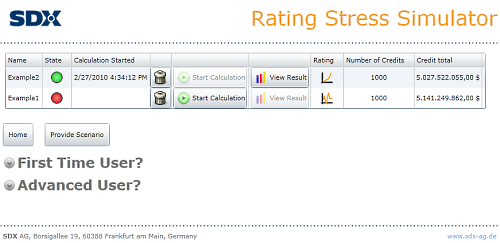
• Matthias Jauernig describes the live Azure Rating Stress Simulator application in his Will Windows Azure succeed? post of 3/6/2010:

On PDC 2008 Ray Ozzie went out on a limb by saying that Windows Azure will be “setting the stage for the next 50 years of systems”. Everyone (me too) was excited about this new technology and people got inspired by Microsoft’s vision and its new cloud computing platform.

16 months later, here we are: Windows Azure is live, the platform has been consolidated (R.I.P., Live Framework…) and data centers have been built up around the world.

But is Windows Azure this game changer that Microsoft promised and which they bet on? Will Windows Azure (as product) succeed? I’m not sure, but let’s see…

First things first

My thoughts on this topic have a certain background. In 2009 my company SDX invested significant research time into the innovative areas of cloud computing in general and Windows Azure in particular. And we’re still moving forward in this area. In scope of the NewCloudApp() contest we made up a little showcase named Rating Stress Simulator which you can see on the right and which you can try out now on Windows Azure. …

Matthias continues with a plea to make Windows Azure more attractive to hobby developers, a feature that Tim Anderson and I also believe Azure lacks.

• Mike Kelly describes A PowerShell Cmdlet for Managing Windows Azure Diagnostics in this 3/5/2010 post:

I decided to write a PowerShell cmdlet to manage Windows Azure diagnostics.  This cmdlet will let you retrieve and delete log information in the Azure cloud for your service; right now there isn’t any easy way to do this.

I started out by writing a simple spec for my tool; you can see it here.  The spec just lets me flesh out some of the design issues before writing code.

I found that there is a PowerShell 2.0 SDK released a couple of months ago; I installed that.

Next, I fired up Visual Studio 2010 and looked for a template to create a PowerShell Cmdlet.  Turns out there isn’t one.  So you just create a class library; all there is to a PowerShell Cmdlet is an assembly that inherits from Cmdlet (or PSCmdlet). …

Mike continues with his narrative about how he finished the Cmdlet. He’s Director of Emerging Practices in Microsoft's Engineering Excellence group.

• Shuttervoice.com reports Largest Image Update For Bing Maps, Says Microsoft in this 3/6/2010 post:

Microsoft Bing Maps has undergone a so called Largest Image Update Ever in Maps in measurement of square kilometers. It’s been said by Microsoft that, they have underwent the largest update of 6.7 million square kilometers.

With this update there is new aerial and bird’s eye imagery structure in the maps on several continents as in the picture below:

Bing Maps

The Bing Maps World Tour shows updates on the Map. In another image below we can see the statistical data on a large basis for many countries.

Brent Stineman’s Azure Service Configuration Updated (or “Where did RoleManager go?”) post of 3/5/2010 begins:

In May of 2009, I wrote a blog posting that covered the basics of Azure Service Configuration Options. When I was looking through my blog statistics lately, I noted this posting is seeing a significant amount of traffic. This is tragic because the November release of the Windows Azure platform broke much of what I discuss in that posting. So I figured it was time to do right by that topic and make an update. :)

Brent continues with descriptions of changes to ServiceConfiguration.cscfg and ServiceDefinition.csdef files in the Azure release version.

Ryan Dunn and Steve Marx posted the Cloud Cover Episode 3 - Worker Role Endpoints Webcast to Channel9 on 3/5/2010:

Join Ryan and Steve this week as they cover the Microsoft cloud.  You can follow and interact with the show at @cloudcovershow
In this episode:

  • Learn how to host other web servers in Worker Roles.
  • Hear about some new tools for working with SQL Azure.
  • Find out how to calculate the size of your database and objects in SQL Azure.

Show Links:

Steve Marx explains Using Other Web Servers on Windows Azure in this 3/5/2010 post:

Ryan Dunn and I recently recorded the third episode of our new Channel 9 show, Cloud Cover, which should go live on Channel 9 tomorrow (Friday). In this week’s episode, I do a demo of a worker role with an input endpoint. That’s a fancy way to say I use a non-IIS web server in Windows Azure.

The technique I demonstrate is exactly the same as what’s used by our Tomcat Solution Accelerator, but it’s also been used to run Apache, Mongrel, and other web servers. In this post, I’ll show how to run Mongoose, a tiny web server, in the cloud.

Steve’s post covers the following topics:

    • Background: Endpoints in Windows Azure
    • Worker Roles with Input Endpoints
    • Listening for Traffic on the Right Port
    • Launching a Web Server
    • Packaging the Web Server with Your Role
    • Try It Out

He concludes:

I’ve zipped up everything (except the Mongoose binary) so you can try this sample yourself. To get the application working, just download Mongoose and place it in the Mongoose folder under the worker role.

Note that because you don’t have an HTTP input endpoint, Visual Studio doesn’t know to launch the web browser. To view the application once it’s running, open up the Development Fabric UI and check what port you’re on (should be port 80, or often 81 or 82 if you’re running other things). Then just browse to localhost on that port in the browser.

Download the full VS2010 RC solution here.

It’s also running in the cloud (for a week or so until I pull it down) at http://workerinput.cloudapp.net.

It’s good to see Steve back in the blogging business.

Nuno Silva begins a A simple, yet interesting scenario with this initial post of 03/03/2010:

Today I had the chance to exercise myself in the Evangelist role when I was confronted with a simple, yet interesting application scenario. I was asked for advice on how to build a small application that had some interesting requirements:

  • A simple Silverlight “control” to be placed in a portal, which will be reused for several other portals in different countries.
  • The control must allow both read and write access to a set of data
  • Due to budget constraints, the organization doesn’t have the resources to acquire a database server to hold that data …

In the end, after carefully analyzing our alternatives, we came up with the following solution:

  • Silverlight control (it is a requirement and I would have advise it anyway)
  • Database hosted somewhere in the cloud
  • Service hosted on Azure to provide both read and write access to the data
  • Depending on what they want to achieve they can opt for a WCF service or a REST service (using ADO.NET Data Services).

He continues the process with A simple, yet interesting scenario: creating a database on Microsoft SQL Azure of 03/04 and A simple, yet interesting scenario: hosting a WCF service on Windows Azure of 03/05.

Nuno (@nuno_ms) is a Developer Evangelist at Microsoft Portugal. I’ve subscribed to his feed.

See the /n software inc. post about its new RSSBus for Azure (Beta) in the AppFabric: Access Control and Service Bus section

Return to section navigation list> 

Windows Azure Infrastructure

Microsoft posted a new Cloud Services portal to coincide with Steve Ballmer’s The Cloud: Exciting New Possibilities presentation at the University of Washington’s Paul G. Allen Center for Computer Science & Engineering of 3/4/2010 with the theme of “We’re all in” [the cloud.]

Ballmer3-231px So, what I'm going to try to do is share with you five key dimensions in the cloud, five key opportunities, five key things that I think need your best ideas, your best thoughts, your best invention, commercial inventions, academic inventions, product inventions to really drive forward. And I'll give you a little bit of context about what Microsoft is doing in that regard.

In brief, following are Steve’s “five key dimensions in the cloud:”

    1. The cloud creates opportunities and responsibilities. …
    2. The cloud learns and helps you learn, decide and take action. …
    3. The cloud enhances your social and professional interactions. …
    4. The cloud wants smarter devices. …
    5. The cloud drives server advances that, in turn, drive the cloud. …

A full transcript of the 01:15:48 speech is here. Following is Microsoft Cloud Services’ new motto:

image

Tim Anderson posted his Microsoft maybe gets the cloud – maybe too late analysis of Ballmers take on Azure on 3/5/2010:

Someone asks if Microsoft is just reacting to others. Ballmer says:

“You know, if I take a look and say, hey, look, where am I proud of where we are relative to other guys, I’d point to Azure. I think Azure is very different than anything else on the market. I don’t think anybody else is trying to redefine the programming model. I think Amazon has done a nice job of helping you take the server-based programming model, the programming model of yesterday that is not scale agnostic, and then bringing it into the cloud. They’ve done a great job; I give them credit for that. On the other hand, what we’re trying to do with Azure is let you write a different kind of application, and I think we’re more forward-looking in our design point than on a lot of things that we’re doing, and at least right now I don’t see the other guy out there who’s doing the equivalent.”

Sorry, I don’t buy this either. Azure does have distinct advantages, mainly to do with porting your existing ASP.NET application and integrating with existing Windows infrastructure. I don’t believe it is “scale agnostic”; something like Google App Engine is better in that respect. With Azure you have to think about how many virtual machines you want to purchase. Nor do I think Azure lets you write “a different kind of application.” There is too little multi-tenancy, too much of the old Windows server model remains in Azure.

Finally, I am surprised how poor Microsoft has become at articulating its message. Azure was badly presented at last year’s PDC, which Ballmer did not attend. It is not an attractive platform for small-scale developers, which makes it hard to get started.

Mary Jo Foley’s The cloud slide Steve Ballmer should have shown of 3/4/2010 suggests Lynn Langit’s slide as more appropriate to Microsoft’s cloud story:

Based on his presentation, Ballmer seemingly was using the terms “cloud” and “Internet” interchangeably. But to me, the Web is not the same as the cloud. Then again, maybe I’m just splitting hairs…

I understand that there is no single cloud. Is Microsoft Hotmail a cloud app? Sure, it runs in Microsoft’s datacenters somewhere. Ditto with Xbox Live, the Danger Sidekick services, Office Web Apps, Windows Live services, Microsoft’s hosted Business Productivity Online Services (BPOS), etc. There are lots of Microsoft servers different Web-based apps and services out there, all of which could be called part of “the cloud” even though none of the ones I’ve mentioned is running on Microsoft’s Windows Azure.

Oh yeah. Azure …. When most pundits and industry observers talk about Microsoft and its cloud strategy, they mean Azure. I bet a lot of Microsoft’s customers and developers think this way, too. Ballmer made very few references in his UW talk today to Azure — maybe because on the Azure cloud front, Microsoft is playing catch up (at least timing-wise) to others already out there, including Amazon, Google, Salesforce and more.

Ballmer said Microsoft would support the public cloud, the customer (private) cloud, the partner cloud and the governement cloud. Until today, I felt Microsoft’s story about how it would do this was pretty clear and straightforward. It was software+services and/or three-screens-and-a-cloud. According to that “story,” Microsoft offers users a wide span of choices: Run your applications on-premises; partially on-premises and partially in the cloud; or completely in the cloud. On the cloud side, these applications can be hosted by Microsoft partners and/or Microsoft.

In other words, like this. (Click on the slide below to enlarge. Note IaaS is Infrastructure as a service and PaaS is platform as a service.):

(from “Introduction to Windows Azure” by Softie Lynn Langit) …

See Lynn’s Intro to Windows Azure from MSDN Irvine, CA Event post of 3/4/2010 in the Cloud Computing Events section.

Mary Jo links to Jason Kincaid’s Steve Ballmer’s Memo To Microsoft Staff: “We Must Move At Cloud Speed” post of 3/4/2010 to TechCrunch, which carries the full text of Steve’s “all-staff” email about the five dimensions and requests Microsoft employees to:

    • Watch the speech on demand here
    • Learn more about our cloud offerings and how they relate to our overarching software plus services strategy here
    • Review your commitments to ensure you are landing our vision with customers and partners.

Mike Wickstand of the Windows Azure team has posted a quick survey which requests users to choose between manual, automatic, or delayed automatic upgrading of the guest operating system in Microsoft data centers. It took me about two minutes to complete it.

Charlie Burns and Robert McNeill co-authored the User IT Trends Breed Alternatives to Traditional IT Management Research Alert of 3/4/2010 for Saugatuck Resarch:

Recent announcements by significant IT players continue to indicate new dynamics in the traditionally lethargic arena of IT systems management. New offerings are threatening the status quo of the “Big Four” (i.e., BMC, CA, HP, and IBM).

What is Happening?

As we recently detailed in Strategic Perspective MKT-708, “The Cloudy Future of IT Service Management,” published 26 Feb. 2010, IT service management (ITSM) is one of the traditional IT support functions that are being targeted by a new set of vendors. User IT organizations are selecting from a growing list of functionally-rich alternatives with an array of implementation options ranging from traditional on-premise solutions to on-premise appliances to SaaS and cloud-based tools. …

Charlie and Robert continue an analysis of the IT management tool market, which includes cloud computing data centers.

Enterprise Management AssociatesNew EMA Research Examines “The Responsible Cloud” press release of 1/13/2010, which I missed when published, reports:

Enterprise Management Associates (EMA), a leading IT management research and consulting firm, today released its latest research report entitled, “The Responsible Cloud.” … Some of the key findings in the report include:

  • 76% of all enterprises report that cloud computing has resulted in real, measurable cost savings. Discounting those that have not measured or cannot tell, 89% of enterprises with production deployments report a real, measurable cost reduction as a result of implementing cloud computing.
  • Service improvement and cost reduction are the most important drivers and the strongest outcomes. Over 75% of enterprises report CapEx and/or OpEx savings – on average over 20%. However, HR issues, politics, lock-in, and management are all rated as critical barriers to success.
  • 70% of experienced organizations rate the role of IT Management as highly important to the success or failure of cloud computing.

There is no doubt as a result of this research that cloud computing requires far more attention than the slap-dash “cowboy” efforts that many seem to advocate. It requires a carefully planned approach that establishes a firm foundation in virtualization and infrastructure management, adds careful attention to core principles of IT and business service management, and assures commitment to principles of security and compliance throughout. …

<Return to section navigation list> 

Cloud Security and Governance

• Lori MacVittie claims “The current threat level is … the same as it was yesterday, and the day before, and will be tomorrow” in her When Everything is a Threat Nothing is a Threat post of 3/5/2010:

image We’ve all been in the airport before and heard the announcement. “The current threat level is orange. Blah blah blah blah yada yada whatever.” At least that’s what I hear today because I’ve become immune to the fact that “orange” means there’s a threat. There’s always a threat, it seems, and the announcement simply conveys what appears to many of us to be the “status quo.” We have effectively been desensitized to a “higher” threat level as it is now treated as nothing out of the ordinary. It is the norm, rather than something that grabs our attention. 

The same is true in the enterprise, where the threat level is always high. Although most organizations likely don’t have a “threat level announcement” the effect is the same: personnel and infrastructure alike treat this allegedly “heightened awareness” as the status quo. It’s no longer actually heightened, or more aware, it’s the way it always is. Many times this is because there’s always a credible threat to the infrastructure and applications of any organization. At any time there may be an incursion, an attempt at penetration, the exploitation of an old or newly discovered vulnerability. This forces information security teams to put into place the infrastructure and solutions, both active and monitoring, that will detect and (one hopes) prevent a successful attack. These solutions are always on alert, twenty-four by seven, three-hundred sixty-five days a year. …

A dynamic infrastructure, enabled by Infrastructure 2.0, however, might resolve this problem – or at least give us the means by which we can architect an infrastructure that can. …

K. Scott Morrison asserts REST Security Does Exist—You Just Need To Apply It in this 3/4/2010 post:

On the eve of the RSA conference this year, Chris Comerford and Pete Soderling published a provocative article in Computerworld titled Why REST security doesn’t exist. It’s a prelude to a talk the author’s are delivering at the conference. Their premise is that while good REST security best practices do indeed exist, developers just don’t seem to follow them.

Comerford and Sodering attribute this state of affairs to a combination of two things. First, REST lacks a well-articulated security model. Few would argue with this—REST, by virtue of it’s grassroots origins, suffers from a security just-do-it-like-the-web nonchalance that’s certainly done it no favors.

The second issue concerns developers who tend to rush implementation without giving due consideration to security. Truthfully, this is the story of security across all of IT, but I might suggest that with REST, the problem is especially acute. The REST style owes much of its popularity to being simple and fast to implement, particularly when faced with the interest-crushing complexity and tooling demands of the WS-* stack. It’s reasonable to think that in the enthusiastic dash to cross the working application finish line, that security is conveniently de-emphasized or forgotten altogether. …

Scott implements Comerford and Soderling’s recommendations in a simple policy for the Layer 7 Technologies SecureSpan Gateway:

Mike Kirkwood suggests “potential upgrades to 802.1 would enable a richer dialog between the server as it starts up its networking process” in his Reinventing the Handshake: Polite Servers and Smart Networks Lead to Active Security post of 3/4/2010:

handshake.jpgIf there was a real-time tag cloud for the RSA conference this year, three words would be in big bold letters: Security (of course), Cloud, and Virtualization. Paul Congdon, from HP's ProCurve Networking group gave us a view into the not-so-distant future where servers, like good house guests, knock before entering. In this case, it's the link they request, and to get it they will properly announce themselves and their intentions to allow the host to prepare to accommodate them.

This capability is a linchpin in removing the process bottleneck in provisioning new services in the data center. For most organizations, the network is manually configured. To keep up with the movement of the provisioning of virtual machines, the network needs to enable "plug and play".

802.1.x is technology that has been used in WiFi connections. One reason it was useful in that context is that it's expected that the link drops and reconnects frequently and so is seen as an opportunity for the physical link as well.

802.1RevisionHistoryFull.jpg

B&L Associates quotes Forrester Research in this Business Balking on Cloud Storage post of 3/4/2010:

Cloud_question While the cloud may have an irresistible attraction to some businesses for some purposes, storage doesn't seem to be one of them---at least according to some recent findings from Forrester Research. In a report titled "Business Users Are Not Ready For Cloud Storage," the firm disclosed that IT decision makers in North America and Europe just aren't ready to trust the cloud with their data.

"Given that data storage capacities are growing at 30 percent to 40 percent per year but storage budgets are flat or growing minimally, IT professionals are eager to take advantage of the low cost per gigabyte offered by cloud providers," the report's executive summary noted.

"Storage vendors are eager to be the ones to provide storage-as-a-service or supply storage systems to the cloud providers," the summary continued. "However, data from Forrester's 2009 hardware survey shows that this is just talk, so far."

Don't look for companies to trust their data with services like Amazon S3, EMC Atmos, Nirvanix, The Planet or AT&T Synaptic Hosting any time soon, warned the report, penned by Forrester researcher Andrew Reichman with Stephenie Balaouras and Alex Crumb. "There is long-term potential for storage-as-a-service, but Forrester sees issues with guaranteed service levels, security, chain of custody, shared tenancy, and long-term pricing as significant barriers that still need to be addressed before it takes off in any meaningful way," the summary said.

Not surprisingly, the top concerns of the techies polled for the report about cloud storage were privacy and security. No doubt the recent breach into Google's computers by Chinese crackers threw gasoline on those burning concerns. Of the 2200 IT executives interviewed for the report, 49 percent of those from enterprises and 51 percent from small- and medium-sized businesses cited those concerns for not using the cloud. …

John Pescatore asks Cloud Computing: Will It Be Government’s Venus Fly Trap? in his 3/4/2010 post to the Gartner blog:

The cryptographer’s panel at the RSA conference is always my favorite part. At this year’s conference, Adi Shamir (the S in RSA) made a comment along the lines of “One of my fears for the future is that cloud computing is a ‘dream come true’ for government intelligence agencies.” He actually used a more colorful term for ‘dream come true’ but his basic point was something I point out to Gartner clients all the time: in many countries (the US included) companies are legally (and often illegally) required to cooperate with government requests to surreptitiously monitor communications and content flowing through or stored on their systems.

There is a school of thought that true cloud computing means no care at all about the physical location of the storage. The fact that many governments can compel any company or service provider operating in their country to expose their customer’s data means for real businesses, location does matter.

He continues with an analysis of potential solutions including encryption, striping or scattering the data across multiple data centers in multiple countries, striping/scattering encrypted bits and “tokenization as a service,” which John believes offers more promise.

John is an analyst in Gartner’s security group.

<Return to section navigation list> 

Cloud Computing Events

ebizQ announced Cloud QCamp 2010 on April 7, 2010 in this 3/6/2010:

ebizQ has been covering Cloud Computing for the last three years. Last June, ebizQ organized a Cloud Qcamp virtual conference, where leading industry experts and practitioners explored the role of service-oriented architecture (SOA) and business process management (BPM) in supporting cloud-computing initiatives. This April, ebizQ will help enterprises cut through the hype and focus on issues surrounding cloud computing, covering Infrastructure as a Services (IaaS), Platform as a Service (PaaS) and Software as a Service (SaaS). This year's QCamp will also focus on development of Private Clouds in Enterprises.

Webinars include:

  • The Economics of Cloud Computing: Joe McKendrick
  • Best Practices in Moving Data to the Clouds: David Linthicum
  • How Can the Cloud Fit Into Your Applications Strategy?: Phil Wainewright
  • Can the Cloud be Governed?: Joe McKendrick
  • Platform as a Service: How to Avoid Lock-In: Phil Wainewright
  • What is Virtualization and Cloud Computing, and How Interconnected Are They?

• Lynn Langit posted on 3/6/2010 a link to her SQL Azure slide deck from the ‘Day of Azure’ event in San Diego on the same date:

• Zoli Erdos Under the Radar: Commercializing the Cloud – Apply to Present / Discount Tix Here post of 3/5/2010 to the Enterprise Irregulars blog announces:

UtR-Iam-Going Under the Radar is Silicon Valley’s most established startup debut platform: a conference series organized by Dealmaker Media, covering business applications, social media, entertainment, mobility..etc.

This year’s conference in Mountain View, CA on April 16th will focus on Commercializing the Cloud – that’s a fairly wide definition, and one that perfectly mashes with our focus over @ CloudAve, so we’re proud to be Media Partners at this event. That means we’ll be covering it before, during and after, and if you decide the attend, we’ll get you in at a discount rate.

In this American Idol of startups typically 32 finalists are selected, who are grouped in categories of 4 each and each has about 15 minutes to present in two parallel tracks. They get grilled by the judges and audience, and at the end of the conference the winners of each category are announced.  A few years ago I participated in the pre-selection of startups, and I remember having checked out hundreds of companies to come down to the finalist set.  At the moment 19 finalists are announced:

AppDynamics, AppFirst, Aprigo, Cloudant, CloudShare, CloudSwitch, Conformity, CubeTree, Fonolo, GoodData, Layerboom Systems, Makara, MaxiScale, Neo Technology, NorthScale, Reductive Labs, RiverMuse, SaaSure and SendGrid.

This means two things:

  • A dozen or so slots are still open
  • The Selection Committee will likely sift through another 100+ applications to fill those slots.

So if you consider your startup a (future) leader in Saas | Collaboration | Business Apps | Development Tools | Compliance |  (and more!), don’t waste time, apply here to be a presenter. …

Vittorio Bertocci (a.k.a., Vibro) reports on 3/4/2010 Coming to a City Near You: Windows Identity Foundation Developer Workshops!:

image

3/29-3/30 - Brussels, Belgium
4/7-4/8 – Chertsey, UK
5/_-5/_ - Munich, Germany
5/18-5/19 – Singapore
5/_-5/_ - Sydney, Australia
6/1-6/2 – Redmond, USA

Want to gain deep, hands-on knowledge on Windows Identity Foundation? Well, we may just have what you need here!

By the end of this month I’ll hop on a plane and start going around the world, delivering 2-day workshops about WIF.

The Workshops Format

2 days of full immersion in Claims-Based Identity and Windows Identity Foundation, where traditional lectures are alternated to instructor-led labs. Everything will be as interactive as it can be, so that you can squeeze as much value as possible from your participation: which is why I am personally flying to every location for delivering the training. …

… Apart from the first 30/40 mins on day 1, the workshop content is quite deep and designed for a developer audience. Architects are welcome as well, provided that they are hands-on and know their way in Visual Studio.

We will touch on all the standard stuff, then we’ll dig deeper on some key topics (extensibility, custom STSes on-premises and in Windows Azure, WIF and Silverlight, WIF+WCF+Windows Azure, etc). [Emphasis modified.]

The idea is not (only) to give you a list of recipes of how to handle a list of given scenarios, but to make you understand what makes WIF tick so that you know where to put you hands and what to change in every occasion. Perhaps even more important, during the 2 days spent together I will challenge you to learn to think in term of claims about your scenarios: if you get that, all the rest is quite literally syntactic sugar. …

How to Participate

Aaaand we finally get to the interesting part. How to participate? The event is free of charge, apart of course for your T&E if you need to travel to the venue. Unfortunately the highly interactive nature of the workshop format (and the requirement to provide PCs for the labs) imposes hard limits on the number of participants, less than 20 people per event. If you want to attend, don’t hesitate!!! The current schedule is [above]. …

If you live in Belgium, UK, Singapore or US and you want to participate to the workshop please get in touch with your local DPE contact.

If you live in Germany or Australia: the two workshops there are still not confirmed, but we are working on it. If you would be interested in participating, please let your local evangelist know.

Lynn Langit’s Intro to Windows Azure from MSDN Irvine, CA Event post of 3/4/2010 provides links to her presentation slides and more:

Expanded deck from yesterday’s talk – includes information on Windows Azure data storage options as well as basic introduction to cloud computing and Microsoft’s Windows Azure offering: Windows Azure Introduction. View more presentations from lynnlangit.

Here’s an image that I like (from Microsoft’s PSA Keith Pijanowski) which shows a logical representation of Microsoft’s Windows Azure cloud computing offering:

Windows Azure Cloud Computing
Keith has also written a blog post about IaaS, PaaS and SaaS that I found to be helpful – link here.

Also, here’s a link to a comparison of the cloud computing offerings from vendors other than Microsoft (requested by the audience in Irvine).

By the way, after you build and deploy your first cloud application (using ANY vendor), I’d love to hear more about your experiences (good or bad) – drop me a line via this blog.

“[T]his blog” means Lynn’s blog. Lynn (@llangit) is a.k.a. SoCalDevGal.

Brien Loesgen reminds Southern Californians on 3/5/2010 that San Diego:Windows Azure Conference is Tomorrow! (Saturday):

San Diegans, time is running out, the Windows Azure conference (I blogged about it here) is *tomorrow*. This is a great opportunity to ramp-up quickly on what Windows Azure is, and how it can be used in the real world. Come see why everyone is so excited, and why everyone agrees that this is a major shift in our industry. This is not future-tech, the cloud isn’t vapor anymore :) – this is live and production-ready today.

I will be presenting on Windows Azure platform AppFabric, and specifically how to leverage it to bridge between on-premise and off-premise (or, from–one-premise-to-another-premise).

Hope to see you there!

IDC reports its Directions 2010 Capitalizing on the Recovery: Building the Foundation for the Intelligent Economy 45th annual industry/business briefing will take place on 3/10/2010 at the Santa Clara Convention Center, Santa Clara, CA:

Recent economic conditions have brought near-death experiences for many of the industries' largest players, exposing massive inefficiency, dangerously poor visibility and transparency, and a painfully slow ability to innovate and adapt. As the world slowly recovers from recession, it's no surprise that almost every industry is poised for significant - and, in many cases, long overdue - restructuring and transformation. A common element of industry transformation and revitalization is a deeper embedding and leverage of ICT to foster an intelligent economy, greatly improve growth and efficiency, and stave off future crises.

The Windows Azure Team suggests that you Submit Your Solution for the Windows Azure Platform Partner of the Year Award in this 3/3/2010 post:

Are you a Microsoft partner who has built and delivered an innovative solution on the Windows Azure Platform? This year we're showcasing more partner solutions than ever before at the Microsoft Worldwide Partner Conference (WPC) 2010 to be held in Washington, D.C.  July 11 - 15, 2010. Don't miss this opportunity to get your innovative solution recognized with a Microsoft WPC 2010 Award!

Winning a Microsoft WPC Partner Award gives you valuable business advantage through public recognition from your peers, press, analysts, and your customers. This year, the WPC 2010 Awards Program is being expanded to showcase more partner solutions than ever, including the newly added Microsoft Country Partner of the Year award. Past winners have demonstrated significant customer impact, solution innovation, speed to market, deployment, and utilization of advanced features in Microsoft technologies and have optimized Microsoft technologies to meet customer business needs and exceed expectations.

Receive onsite acknowledgement at WPC 2010 and take advantage of a comprehensive marketing and press kit designed to help you attract prospects and gain new customers. Click here for more information and find out how to submit your entry to become the Windows Azure Platform Partner of the Year Award winner.

<Return to section navigation list> 

Other Cloud Computing Platforms and Services

Dan Worth reports from CeBIT “Security must remain the top priority as businesses rush to embrace cloud computing to help reduce expenditure and improve sales, according to Werner Vogels, chief technology officer at Amazon Web Services (AWS)” in his CeBIT 2010: Firms told to focus on cloud security post of 3/5/2010:

Speaking at the CeBIT trade show today, Vogels said AWS is seeing increasing demand for its services, as it is able to offer the scalability and flexibility that companies need to work in today's IT and business environments.

"We are seeing firms taking advantage of services for traditional reasons such as web hosting or software distribution, but also in new areas like disaster recovery and large-scale analytics," he said.

Vogels added that many IT chiefs see cloud computing as an integral requirement in any purchase of new services, underlining its growing importance to businesses now and for the future.

"CIOs are making bold moves in the cloud space and demanding that new technologies are cloud-ready, not only in areas where it is obvious that technology needs to work in the cloud, such as web hosting or marketing campaigns, but also in areas like media distribution or collaboration tools," he said.

However, he stressed that firms must make sure security remains key when considering cloud products, both to protect their investments and to adhere to data protection laws. …

See Jnan Dash Elastic Database Cloud? post in the SQL Azure Database (SADB) section, which asserts “We also see Amazon's SimpleDB is introducing ‘forced consistency’ to the world of ‘eventually consistent’ model.”

<Return to section navigation list>