 Windows Azure, Azure Data Services, SQL Data Services and related cloud computing topics now appear in this weekly series.

Note: This post is updated daily or more frequently, depending on the availability of new articles.
• Updated 1/22/2009 10:00 AM PST
•• Updated 1/26/2009 10:00 AM PST
•• Scott Watermasysk explains Azure Table Storage Key Conventions for PartitionKey and RowKey columns in his 1/23/2009 post.
•• George Crump’s Cloud Storage Matures InformationWeek blog post of 1/23/2009 observes that:
[C]ompanies like Bycast, Cleversafe, Amazon and Nirvanix have real customers paying real money to use their products or services. Companies like EMC and HP are bringing legitimacy to the concept and companies to watch like ParaScale are moving through the development cycle. …
[Y]ou can consider other options to the cloud storage wave. While leveraging your backup process should not be considered, (see our article Backup vs. Archive) Disk Archive solutions like those from Permabit and Nexsan are an alternative to consider.
•• Rob Bagby describes how to avoid IIS 7.0’s dreaded “The security certificate presented to this website was issued for a different website’s address” in his Self-Signed Certificates on IIS 7 – the Easy Way and the Most Effective Way post of 1/23/2009.
Note: Clients receive this error if you use the approach recommended by Scott Guthrie in his Tip/Trick: Enabling SSL on IIS 7.0 Using Self-Signed Certificates post of 4/6/2007. Rob demonstrates the workaround.
• Dare Obasanjo concludes in his Cloud Computing Conundrum: Platform as a Service vs. Utility Computing post of 1/22/2009:
As it stands today platform as a service offerings currently do not satisfy the needs of people who have existing apps that want to "port them to the cloud". Instead this looks like it will remain the domain of utility computing services which just give you a VM and the ability to run any software you damn well please on the your operating system of choice.
Dare cites the lack of a “SQL database in the cloud” and the need to rewrite Windows Azure applications to remove reliance on relational features such as foreign keys, joins, triggers, and stored procedures to be “adoption blockers.” SQL Data Services now emulates joins, but not other RDBMS capabilities. Amazon EC2 running Windows 2003/SQL Server 2005 instances is a partial solution to the “drop in your ASP.NET project” but I’m still not sanguine about the scalability of SQL Server instances with .mdf/.ldf files in the Elastic Block Store.
Note: Dare cites Tim O’Reilly’s Web 2.0 and Cloud Computing post of 10/26/2008, which discusses the thread of a cloud computing infrastructure monopoly, defines key cloud computing models, and predicts that supplying cloud infrastructure will be a low-margin business.
Richard Jones’s Anti-RDBMS: A list of distributed key-value stores post of 1/19/2009 provides a list and Java-centric analysis of today’s distributed key-value persistence stores, such as BigTable and Hadoop. (Azure Table Services and Amazon SimpleDB are distributed key-value stores.) Richard’s post prompted the following Tweet from Dare Obasanjo:
Carnage4Life Reading http://bit.ly/JXtx reminds me that I have to finish my Anti-Anti-RDBMS post. The way I see it BigTable has set us back five years.
The computer science folks at UC Berkeley, such as Joseph Hellerstein, believe BigTable, Hadoop, and MapReduce are a better approach to big data than SQL. UC Berkeley’s EECS department in 2008 replaced relational database systems (RDBMSs) and SQL with Hadoop and MapReduce in the introductory computer science curriculum.
•• Nic Smith’s Microsoft BI Strategy Update post of 1/23/2009 reports:
Based on customer feedback, we’re announcing today that Microsoft is consolidating the scorecard, dashboard, and analytical capabilities from PerformancePoint Server into SharePoint Server as PerformancePoint Services, making these capabilities available to millions of SharePoint users around the world.
For more information, watch Guy Weismantel’s video. Guy is Director of Microsoft BI.
This move to increase PerformancePoint’s demographics might speed arrival of the promised SQL Business Intelligence Service, as mentioned by Arthur Cole in his Appliances and the Cloud — Two Great Tastes…? post of 1/9/2009 in which he says:
Microsoft in particular seems to be heading toward a cloud/appliance model with the expected development of a new SQL Server-based appliance created from technology acquired from DATAllegro. And if that appliance shows up in the SQL Server Data Services plan as expected, you’ll have the ability to manage vast amounts of data across literally thousands of nodes. [Emphasis added.]
• James Johnson supplements his MSDN Webcast: geekSpeak: SQL Data Services with James Johnson (Level 200) Webcast of 1/14/2009 with three tutorial posts about SDS:
- SQL Data Services Adventure - Day 1: Introduction to SDS and the Azure Services Training Kit
- SQL Data Services Adventure – Day 2: The ACE model
- SQL Data Services Adventure – Day 3: Universal Resource Identifiers (URIs) and security
• Quantivo’s White Paper: The Case for Sofware-as-a-Service Analytics (requires registration) argues:
In the Business Intelligence and analytics market where expensive and hard to use solutions are frustrating managers and business analysts alike, SaaS solutions offer cheaper, easier to deploy and use alternatives. The Quantivo analytics service combines revolutionary technology with cloud-computing, enabling a fundamentally new approach to delivering customer behavior analytics at scale.
The SDS team continues to mention analytics (and reporting) services as forthcoming Azure SQL Services but the team doesn’t mention an estimated delivery date.
Dave Graham’s Cloud Optimized Storage Solutions: Tiering & Expectations article of 1/20/2009 for Cloud Computing Journal discusses supporting the following Information Lifecycle Management tiers in the cloud:
- Tier 0 & 1: Performance & Availability Guaranteed Storage
- Tier 2: Availability Guaranteed Storage
- Tier 3: Accessibility Guaranteed Storage
Part 1 of the series (1/5/2009) was subtitled Data Storage Has Been Taken for Granted and Part 2 (1/10/2009) is How is Content Stored in the Cloud?
Dave is a Technical Consultant with EMC Corporation.
• Ryan Dunn’s Azure Issue Tracker Released post of 1/22/2009 describes his new Issue Tracker service:
This sample application is a simple issue tracking service and website that pulls together a couple of the Azure services: SQL Data Services and .NET Access Control Service.
This demo is meant to show a realistic SaaS scenario. As such, it features federation, claims-based authorization, and scalable data storage. [Emphasis added.]
His post provides a detailed, illustrated description of the services architecture, implementation, and usage. You can download the sample code from the project’s page on CodePlex.
Sam Gentile’s Enterprise Service Buses (ESBs) Drive SOA Adoption - Part 3 focuses on:
[A] very high level view of the Neuron ESB architecture. This will help lay a solid foundation for the articles to come. This material in this particular article is influenced by both posts and talks with Neuron’s Architect, David Pallmann.
[See reference to David Pallman below.]
•• Alex Golesh reached episode four of his detailed Silverlight in the Mesh and the “Cloud” – Silverlight Mesh Enabled Web Application and Azure Services (Part 4) tutorial on 1/23/2009. These links point to previous parts Part 1, Part 2, Part 3. Part 1 describes his project:
For quite some time I’m investigating the Azure Services and Live Framework. After gaining some experience, I decided to build simple project - Content Store – to share with you how to build the next generation of applications.
My “Cloud Store” project will use Windows Azure Storage Account to persist content at the cloud, will use Windows Azure Hosted Services as business logic provider (submit contents to the store, display the contents and “purchase” it). Also, my project will use Live Framework Mesh Silverlight applications to provide UI for content submitters and content viewers/buyers.
Note: SMEWA is an acronym for Silverlight Mesh-Enabled Web Application.
• Ryan Dunn’s Azure Issue Tracker Released post of 1/22/2009 describes his new Issue Tracker service:
This sample application is a simple issue tracking service and website that pulls together a couple of the Azure services: SQL Data Services and .NET Access Control Service.
This demo is meant to show a realistic SaaS scenario. As such, it features federation, claims-based authorization, and scalable data storage.
His post provides a detailed, illustrated description of the services architecture, implementation, and usage. You can download the sample code from the project’s page on CodePlex. [Copied from the “.NET Services: Access Control, Service Bus and Workflow” section.]
• Deni Connor reports in Iron Mountain, Microsoft team for online backup of 1/19/2009 that Iron Mountain and Microsoft inked a deal last week to support organizations with System Center Data Protection Manager (DPM) and back them up to Iron Mountain's CloudRecovery.
I’m surprised that DPM doesn’t back up with Microsoft Azure or at least to Microsoft Data Centers. Are Iron Mountain’s servers more reliable than Microsoft’s?
• Charles Babcock’s How The Cloud Enables A New Set Of Personal Applications post of 1/22/2009 to InformationWeek’s Plug into the Cloud blog describes a mash-up that uses Amazon Mechanical Turk workers to translate iPhone or other images of business cards uploaded to an Amazon EC2 app (Lasso2Go) into a Salesforce lead, an email message, or spreadsheet.
Gus Perez of the Azure Tools team updated his original Windows Azure Links post on 1/19/2009.
David Pallman, the author of the Azure Storage Explorer tool and active participant in the Windows Azure forum, posted Azure Blob Sync on 1/19/2009. According to David:
Azure Blob Sync is a GUI tool that syncs a local file folder to cloud Blob storage or vice-versa. Binaries, sources, and documentation are up on CodePlex. …
To keep the sync fast, simple, and safe, it uses a very simple algorithm: a file or blob is not copied from source to destination if there is already an item of that name on the destination side.
Future plans for AzureBlobSync include a command line version you can use in batch jobs and a means of scheduling automated syncs.
David’s Azure Storage Explorer Updated post of 1/19/2009 notes that the new 0.3 preview version has the following updates:
- It's built against the January 2009 Azure CTP.
- Blobs in a folder hierarchy (with prefixes)[, including log folders,] now display and can be viewed.
- Blobs whose names end in ".xml" (like log files) are auto-formatted as pretty XML with whitespace to make them more readable.
•• Waiming Mok, a member of the Azure team, posted Servers vs Green (1/24/2009), a chart that shows the projected contribution to the energy crisis, and consequently the carbon dioxide emission of servers in 2010. One of the suggested solutions:
Migrate to cloud-computing, where virtualization is deployed and the cost of deployment is shifted from CAPX to OPEX, which could made the adoption easier for some businesses. The following requirements would need be solved: security, system availability, IT ownership,
Waiming’s More Cores Slow Computing post of 1/25/2009 cites a Sandia National Lab study that shows the current design of multi-core processors with high core count actually slow down the system performance.
•• Matt Penner’s What is the Microsoft Cloud Platform? post of 1/24/2009 critiques Woody Pewitt’s presentation of the same name at the Southern California CodeCamp 2009 and describes the Windows Azure sign-up process:
Woody, and Lynn Langit who is in the audience, just mentioned the sign on process. It’s a nightmare! Even some of the internal MS people don’t have keys. I think with all the talent that’s in MS they could have designed and built out the whole sign-up and beta key process much better. It’s terrible to put it lightly. The forums are filled with disgruntled users that can’t log in and have no idea what state their application process is in. This is one of those examples where a little more time and care up front would have saved hours and hours of support calls/emails/postings and upset and confused users. OK, that being said check out Lynn’s post on this very subject.
•• Jim Liddle’s The Economics of Cloud post of 1/23/2009 delivers a cost comparison between building and running your own 50,000 node data center (US$ 112.42/node-month), renting a extra-large Amazon EC2 instance with one 4-core CPU (US$ 576/month or $144/node-month) without an operating system.
Note: The on-premises costs are derived from James Hamilton’s Cost of Power in Large-Scale Data Centers post of 11/28/2008.
GigaSpace subscription cost would be $7,500 per CPU per year for 4 * 4 core servers, which would be equivalent of 8 CPUs or US$ 60,000 per year, or US$ 312.50/node-month.
EC2 running four GigaSpaces 4-core instances costs US$ $55,910.40 per year or US$ 291.20/node-month and requires no up-front outlay.
Jim is Director, Sales and Operations, UK, Ireland & Benelux at GigaSpaces. GigaSpaces markets the eXtreme Application Platform (XAP), a highly scalable application server. GigaSpaces XAP lets you deploy applications that use Java, .Net, C++, or scripting languages.
•• My Microsoft Postpones Construction of Iowa Data Center post of 1/23/2009 quotes the ms datacenters blog’s Building a Better Mousetrap a.k.a. Optimizing for Maximum Efficiency in an Economic Downturn post of 1/23/2009 by Arne Josefsberg and Mike Manos:
[W]e’re postponing construction of the data center in Iowa that we recently purchased land for. We are still continuing construction of our facilities in Chicago and Dublin, and are planning to open them as customer demand warrants. [Emphasis added]
•• Cloud Computing Journal writes Cisco's David Bernstein to Present at Cloud Computing Conference in NYC. Bernstein is
VP and General Manager of Network Applications Infrastructure for Cisco Systems, Inc, where he directs product and research efforts around application aware networking and distributed computing. He serves on several industry boards including the IEEE Computer Society Advanced Technology Executive Board.
Bernstein's team runs Cisco's internal Cloud Computing platform and so has first-hand experience in this emerging category. 25 years in software and systems in Silicon Valley in companies including Cisco, Siebel, and AT&T provide him with a deep perspective on applications infrastructure
• Roger Smith reports on 1/22/2009 from the Cloud Connect unconference that Panelists Say Legacy Apps In The Cloud Are A Roll Of The Dice. Roger writes:
The premise of the Thursday morning panel discussion at the Cloud Connect event at the Computer History Museum in Mountain View, Calif., was that it's possible to have the best of both worlds: your legacy applications and the cloud. By the end of the hour-long discussion, many of the 200 or so attendees seemed to have come to the conclusion that enterprise and Web-scale development were worlds apart and moving further away from each other at something approaching the speed of light. …
Asked if Microsoft was "coming out of its cave" on cloud computing, [director of research, Directions on Microsoft Rob] Helm said from his experience that Microsoft has three approaches to the cloud:
- The Microsoft Consumer cloud, with products like MS Live;
- The Microsoft Business cloud, with Microsoft online, Microsoft hosting of packaged apps, such as the 500,000 seats on MS Exchange e-mail, and Microsoft's Dynamic CRM;
- MS Windows Azure. Helm said that Azure isn't strictly your Microsoft apps running in the cloud. Azure will have new apps built with ASP.NET. to run on the Azure hosted Web platform. Currently in beta, Azure apps will run in a tight security "sandbox" to keep from crashing other Azure apps. Helm said it would be necessary to port your current .Net apps to Azure, they can't be run natively on the Azure cloud.
Note: According to Mary Jo Foley’s Microsoft to merge Windows Live and Office Live post of 1/22/2009, the Microsoft Consumer and Business clouds will merge.
• Silicon Valley’s SDForum’s Cloud Services & SOA SIG (formerly the Web-Services SIG) will sponsor a Services in the Cloud Demo Night from 6:30 PM to 9:00 PM on January 27, 2009 at Tibco Software Inc., 3301 Hillview Avenue, Building #2, Palo Alto, CA. Presenters are:
- Mashery: Clay Loveless, Co-founder & Chief Architect
- 2 Others TBD
Mashery offers an on-demand API infrastructure.
• Mike Walker promotes the Microsoft's Generation 4 Data Center Vision - the Architects' Perspective post of 12/8/2008 to the DataCenter Blog. In his post of the same name on 1/20/2009 Mike writes:
The goal of Gen 4 is to modularize not only the server and storage components, which a number of companies are already doing, but also to modularize the infrastructure, namely the electrical and mechanical systems. The real innovation is around the commonality, manufacturing, supply chain and integration of these modules to provide a plug-and-play infrastructure along with modularized server environments. In addition, it is focused on scaling the infrastructure with the business demands, smoothing capital investment, and driving costs down
• Christopher Hoff’s What To Do When Your "Core" Infrastructure Services Aren't In Your "Core?" post of 1/21/2009 discusses issues surrounding “Infrastructure 2.0” that purports to "...enable greater levels of integration between the disparate layers of infrastructure: network, application, the endpoint, and IP address management, necessary to achieve interconnectedness."
• Lori MacVittie, one of Infrastructure 2.0’s thought leaders who works for F5, posted Cloud Computing: Location is important, but not the way you think on 1/21/2009. She writes:
Location is, in fact, important to cloud computing, but probably not in the way most people are thinking right now. While everyone is concentrating on defining cloud computing based on whether it's local or remote, folks have lost sight that location is important for other reasons.
It is the location of data centers that is important to cloud computing. After all, a poor choice in physical location can incur additional risk for enterprises trusting their applications to a cloud computing provider. Enterprises residing physically in high risk areas - those prone to natural disasters, primarily - understand this and often try to mitigate that risk by building out a secondary data center in a less risky location, just in case. …
So choose your provider carefully, based not only on matching your business and technological needs to the model they support but on the physical location and distribution of their data centers.
• Dana Gardner advocates “cloud-computing neutrality” in his Services consumers and developers must now mount pressure for cloud computing neutrality ZDNet post of 1/21/2009.
• Robert Perry’s Obama Tech Teams Touts Cloud Computing post of 1/21/2009 hosts an Obama transition-team video that Perry describes as follows:
On the eve of his inauguration, President-elect Barack Obama’s transition team released a new video that touts the benefits of cloud computing and government transparency.
The Obama team is “attempting to make government institutions more effective,” Beth Noveck, a law professor and a member of Obama’s Technology, Innovation, and Government Reform team, said on the video posted to change.gov.
Cloud computing, which allows consumers and institutions to access their files and projects anywhere via the Internet “is an important change for the federal government because it is dramatically cheaper than the old fashioned way of doing computing infrastructure,” said team member Andrew McLaughlin, head of global public policy and government affairs for Google, a longtime supporter of cloud services.
• Stephen Walther’s Why ASP.NET Developers Should Care about Windows Azure post of 1/11/2009 explains the potential impact of the Azure Services Platform on building scalable ASP.NET Web sites.
• Jonathan Sapir cautions Don't start from scratch with cloud-based business applications in this 12/30/2008 post and recommends starting out with a hosted vertical software-as-a-service (SaaS) solution such as Salesforce.com.
Pete Cashmore’s Mindblowing Numbers From the Obama Inauguration post of 1/20/2009 demonstrates the need for massive scalability when committing to serve live video streams of important and very popular public events.
The Microsoft Hosting Days team presents The Microsoft Hosting Days 2008 Webcast Series for Pure Play Hosters, Telcos, Independent Software Vendors (ISVs), Resellers (VARs), or System Integrators who weren’t able to attend one of the live North American presentations during January through March 2008. The Webcast series is about:
-
Leveraging the Windows Server 2008 for next-generation Windows-Based Hosting Solutions
-
Turning the growing opportunities for SaaS on Windows technology into business advantage
-
Capitalizing on the wide range of business opportunities available with Microsoft Windows-based Hosting Solutions, including Windows-based Hosting for Applications, Hosted Messaging & Collaboration, Hosted CRM, and Hosted Dynamics
-
Aligning your business with Microsoft’s product roadmap to maximize benefits from the planned testing, release and availability of Microsoft products and services, especially with SharePoint 3.0 and IIS 7.0
-
Selling Business-Class Email to small- and medium-sized businesses (SMBs) using Exchange and the Hosted Messaging and Collaboration (HMC) solution.
Following are the topics covered by one-hour sessions in two tracks:
- Business Track:
- Next Generation Hosting
- Licensing under the Service Provider License Agreement (SPLA)
- Selling Business E-mail to Small Business (HMC and Exchange)
- Software + Services - Marketing Best Practices - New!
- Hosting Opportunities with CRM 4.0
- Technical Track:
- IIS 7 for Hosters
- Hosted Exchange
- Silverlight for Hosters
- Windows Server Virtualization
- Windows Server 2008 - Technical Features and Benefits
- PHP on Windows
Although not directly related to Windows Azure many of the topics overlap Azure Platform Services and Amazon EC2 running Windows 2003 R2 and SQL Server 2005. (RightScale’s Windows! SLA! Beta bye-bye! All on Amazon EC2 today! post of 10/23/2008 says “Windows Server 2008 is apparently on the roadmap but not available at present and it’s apparently against the T&C’s to upgrade on your own.”)
The Web Host Industry Review’s When to Choose an Application Service Provider post of 12/19/2004, while a bit dated, remains a good guide to making the move to third-party SaaS, S+S or Web hosting services.
James Urquhart contends that private clouds are to cloud computing as intranet is to Internet in his The argument for private clouds post of 1/19/2009. He writes:
Rich Miller of Data Center Knowledge noted an excellent response by my former Cassatt colleague, Jay Fry to Andrew Conry-Murray of InformationWeek and Eric Knorr of InfoWorld, who contend that there is no such thing as a Private Cloud.
Jay's response is excellent and I absolutely concur. However, I get so frustrated with these "its gotta be off-premises" arguments, that for some time now, I've been trying to figure out a quick and dirty response I can fire off whenever such "puritanism" comes into play.
James’ standard answer to the “no private clouds” argument is:
Internet has Intranet. Cloud Computing has Private Clouds. Similar disruption, localized scale.
I agree.
David Burela has started an Australian Azure Mailing List (ozazure) to which you can subscribe by sending an empty e-mail message to ozazure-subscribe@lists.codify.com and replying to the response.
Patrick Marshall’s Datacenter Managers Doing More with Less article of 1/14/2009 for Redmond Developer News cites Symantec Corp.'s 2008 State of the Data Center study, about which Patrick says:
The study also found that while many datacenter managers are pursuing green IT initiatives, the primary driver for those efforts is cost reduction. Reducing electricity consumption was a goal cited by 54 percent of respondents, followed by reducing cooling costs (51 percent) and a sense of responsibility to the environment (42 percent). …
The Symantec report examined data from a survey in late 2008 of 1,600 datacenter managers in large private- and public-sector institutions located in 21 countries.
Looming IT budget constraints in CY 2009 and possibly 2010 promise that CIOs will take the cloud computing alternative seriously.
•• Alin Irimie describes Symantec’s new GoEverywhere “cloud workspace” (beta version) in his Your Cloud Workspace - Symantec GoEverywhere post of 1/26/2009 as
A secure SaaS-based workspace that allows users to access their preferred third party web-based email, IM, office and other online applications from one central online location.
•• Lew Tucker, Sun Microsystem’s CTO for Cloud Computing, trades “The Network is the Computer” for “Your Data Center is Your Computer” in this Sun Cloud CTO: 'Your Data Center Is Your Computer' post of 1/22/2009 by InformationWeek’s Roger Smith.
• James Urquhart asks Is Google App Engine successful? on 1/22/2009 from the Cloud Connect conference that’s being held at the Computer History Museum in Mountain View, Calif. He contrasts Google App Engine (GAE) with Amazon Web Services (AWS) and finds:
Since its announcement in July 2002, the various services contained under the AWS umbrella have received a steady stream of press and accolades. Much of that is due to marketing (and the phenomenal technology evangelism program Amazon put into place), but part of it as well are successful start-ups passing on their own success stories independent of Amazon.
However, [he] spent the day yesterday at the Cloud Connect conference, hosted at the Computer History Museum in Mountain View, CA. Google was much more visible here (in part because they were a Platinum Sponsor), and perhaps more importantly, the "how to" sessions they hosted Wednesday afternoon were packed by interested developers and technologists.
Click for #cloudconnect tweets. Good reportage!
• John Furrier rings in from Cloud Connect with “Build It Because They Are There” - The Real Meaning of Cloud Connect - It’s About Getting Apps Up and Running of 1/22/2009 that describes how Paul Buchheit and his GMail group built GMail “literally in a day.” John writes:
What we have here is a real time web waiting for real time code. All of the discussion about cloud computing is really about rapid development,provisioning of resources..etc. - in the end a better product for users (hopefully). Paul talks about this in his post -Gmail turned out pretty good.
Cloud computing allows developers the ability to get “stuff” up fast. Speed and feedback is critical to success and more important than having some “hardened app” that no one wants. This is only way to develop in the web today. Success is about speed and product acceptance is dependent on that speed which drives relevance. Build a great product and it will work.
• Geva Perry’s Upcoming Cloud-Related Events post of 1/22/2009 lists world-wide cloud-related events from 1/20/2009 to 6/25/2009. He’s also added a permanent events page at http://gevaperry.typepad.com/main/upcoming-cloud-computingrelated-events.html. Included are six Cloud Camp events.
• Alex Iskold explains How and Why Glue is Using Amazon SimpleDB instead of a Relational Database in this 1/21/2009 post. SimpleDB and Azure Table Services share many characteristics, so the post and its references are valuable for Azure developers.
• John Foley’s Cloud Connect: Tackling The Issue Of Cloud Interoperability post of 1/21/2009 describes the recently formed Cloud Computing Interoperability Forum (Twitter: cloudforum; LinkedIn: CCIF Group) whose mission statement, discussion threads, and contact information for the 449 group’s members as of 1/21/2009 is in this Google Group.
• Mindscape now offers an Amazon SimpleDB Management Tools add-in for VS 2008 that enables the firm’s LightSpeed drag-and-drop object/relational mapping (O/RM) tool to use SimpleDB as a data provider. Thanks to David Hayden for the heads-up.
Mike Brittain describes How We Built a Web Hosting Infrastructure on EC2 for video Web site Heavy.com and related sites in this detailed 1/19/2009 post. Mike automated addition of additional capacity so:
[W]e can add new servers to our production pool in under 20 minutes, from the time we call the “run instance” API at EC2, to the time when public traffic begins hitting the new server. This includes machine startup time, adding custom server config files and cron jobs, rolling out application code, running smoke tests, and adding the machine to public DNS.
It will be interesting to hear whether the Azure team was able to add instances this quickly to any of their large-scale sample sites.
Krishnan Subramanian’s It Is Not A Bloodbath In The Clouds post of 1/19/2009 contradicts Steve Rubel’s Bloodbath in the Clouds Continues as RSS Email Service Shutters post about the demise of RSS FWD, a service that forwards RSS/Atom feeds as e-mail or SMS messages. Krishnan’s point is that cloud computing is closely related to Web 2.0 Software as a Service (SaaS) activities, which are resilient as a whole to recession and likely to survive the current economic downturn. Further, shutdown of a single service doesn’t constitute a bloodbath. Krishnan concludes by pointing out that it is a good policy to investigate the background and analyze the future stability of the SaaS vendors you rely one.
• Update 1/21/2009: I was able to sign up for RSS FWD’s “realtime” notification service, but it didn’t send me a message when I added a new post to the OakLeaf Systems blog today.
Broad Group’s Powered by the Cloud conference will be held in the Lewis Media Centre, Millbank Tower, London on February 2 – 3, 2009. Simone Brunozzi, Amazon Web Service Evangelist for Europe, will participate in the fourth of the following seven panel discussions:
- Making Money from Cloud Computing
Successful business models for providers in the industry - Corporate IT & Cloud Computing
Opportunities and threats to large corporate technology - Finance, Investors & Cloud Computing
What are the key opportunities for investors? - Technologies & Cloud Computing
Obstacles to rollout and the innovations that will overcome them - Consumers & Cloud Computing
Software, web services and the PC industry: what will change? - Infrastructure and Cloud Computing
The coming transformation of internet service providers, data centres and the Internet backbone. - Privacy, Regulation, Security and Cloud Computing
How the industry will maintain the integrity of customer information and the role government will play
Alin Irimie’s Weekly Cloud Application: Eucalyptus post of 1/19/2009 describes the Elastic Utility Computing Architecture for Linking Your Programs To Useful Systems (Eucalyptus) for implementing cloud services on computer clusters. Eucalyptus lets you build cloud services on Amazon EC2.
IBM announced the availability of the LotusLive Engage Beta collaborative cloud-computing service on 1/19/2009, presumably to counter Microsoft’s Windows Live offerings. Following are highlights from the About page:
- Join the LotusLive Engage Beta
- Work outside the corporate firewall
- Connect with companies relevant to your business needs
- Integrated online Web conferencing with essential online business tools
- Online social networking and collaboration service designed for business, without intrusive advertisements
IBM claims that LotusLive Connections (Web collaboration services) and LotusLive iNotes (Web-based messaging services) are “coming soon”, but LotusLive Meetings (a.k.a., IBM Lotus Sametime Unyte Meeting) is available to Buy or Try and LotusLive Events (a.k.a., IBM Lotus Sametime Unyte Events) is available to Try.
It appears to me that IBM has much catch-up to do before LotusLive is ready to compete with Windows Live services on a feature-to-feature basis. As Krishnan Subramanian puts it: IBM Inches Further Towards Cloud Computing.
Technorati Tags:
Windows Azure,
Azure Services Platform,
Azure Storage Services,
Azure Table Services,
Azure Blob Services,
Azure Queue Services,
SQL Data Services,
SDS,
.NET Services,
Cloud Computing,
Amazon EC2,
SimpleDB,
BigTable,
Hadoop,
MapReduce,
Infrastructure 2.0,
LotusLive Engage,
Live Mesh,
Silverlight 2


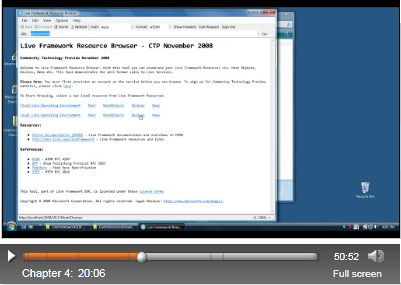

It all started in 2005, three days after Microsoft introduced the “Windows Live” brand on November 1st, 2005, when they announced an acquisition to purchase FolderShare from ByteTaxi Inc, a software which allowed PC-to-PC sync of files and folders over the internet, and also enabled users to remotely access their files from the PCs under the sync relationship. But things didn’t change for almost three years, and for those users who were already using FolderShare, life went on. During these three years, Microsoft had been busy rewriting the entire FolderShare backend sync platform, moving it from LAMP to Windows Server. It wasn’t until March 2008 when Microsoft finally came out of the limelight to release Windows Live FolderShare, the first version under the “Windows Live” branding which was completely rewritten to make it run on the new Windows Server platform. …

So looking into the future, it would appear that one of the highest priority would be for Microsoft to look into the possibilities of merging the Windows Live Mesh storage with SkyDrive’s 25GB, and as such letting users take advantage of SkyDrive’s other features like Office Web Apps. Microsoft also mentioned that they may consider a paid option which allow users to purchase additional storage space in future releases. And what about Mesh for Windows Phone 7? What are your thoughts about the future of Windows Live Mesh? Let us know by leaving a comment below!



 Atom 1.0 site feed


